

A good job ad tells a candidate what they will do, what you need, what you pay, where the work happens and how to apply. Write it in plain words, keep to a few checkable must-haves, show a pay range and describe your process. The ad is also your first screening tool: a clear ad brings fewer unsuitable applications and more people who can actually do the work.
Key takeaways
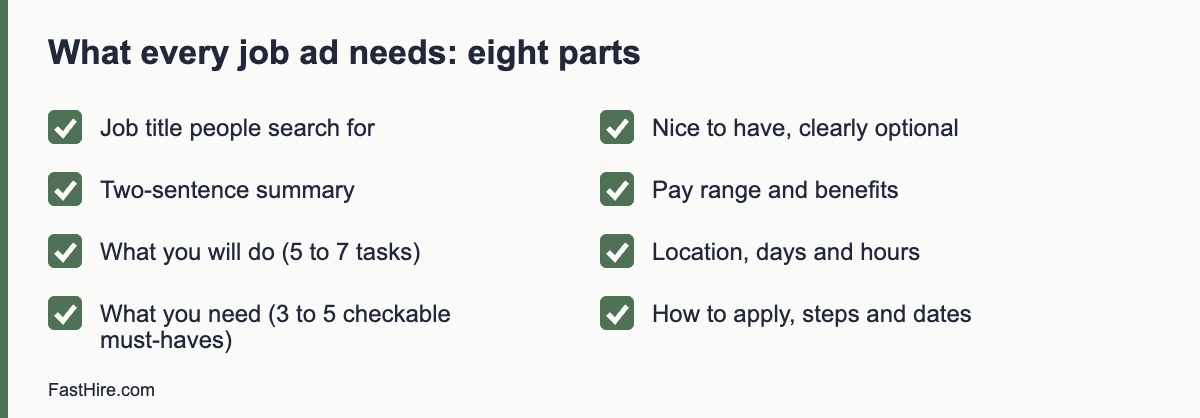
- Use eight parts: title, summary, what you will do, what you need, nice to have, pay and benefits, location and hours, how to apply.
- Limit must-haves to three to five things a person can check in their own CV.
- Show a pay range. It saves time on both sides and, in some places, the law requires it.
- Describe your process and dates so that candidates know what to expect.
- Avoid wording that points to age, sex, race or other protected traits.
Why the job ad matters more than it seems
Most hiring problems that look like “too many bad applicants” start in the ad. A vague ad attracts everyone and puts the whole filtering job on you. A precise ad lets candidates screen themselves. The best ads also respect the reader: they are short enough to read in two minutes, honest about the hard parts of the job and specific about what happens next.
FastHire is being built on the same principle. Candidates check their fit against the requirements before they apply, and employers see each requirement next to the exact CV passage that supports it. FastHire is coming soon. It does not rank, score or reject candidates, and people make every decision. Whatever tools you use, the work starts with requirements that can be checked.
The eight parts of a good job ad
1. A job title people actually search for
Use the common name of the role, such as “Bookkeeper”, “Customer Support Assistant” or “Electrician”. Avoid invented titles such as “Ninja” or “Guru”. Put the level in plain words when it matters, for example “Junior” or “Senior”. Add the location only if the role is tied to one place.
2. A two-sentence summary
Say who you are and why the role exists. Example: “We are a six-person online shop selling home goods. We need someone to keep our customers happy and our orders on time.” Candidates should know within ten seconds whether the ad is for them.
3. What you will do
List five to seven tasks, in order of time spent. Use verbs and objects: “answer customer emails within one working day”, “prepare weekly invoices”, “keep the stock list up to date”. Add one sentence about the hardest part of the job. It builds trust.
4. What you need
This is the must-have list. Keep it to three to five items, and write each so that a person can answer yes or no from their CV. Use “at least one year of customer support work, paid or unpaid” instead of “excellent communication skills”. If a requirement cannot be checked, leave it for the interview. See How to write job requirements candidates can actually check themselves against and Must-haves vs nice-to-haves for more.
5. Nice to have
Keep this short, and say clearly that people without these items are welcome to apply. Never screen out on a nice-to-have.
6. Pay and benefits
Show a pay range and the pay period, for example “per year” or “per hour”. List the benefits that matter to most applicants: holiday, pension or retirement plan, flexible hours and training. Do not list benefits you do not offer.
Pay information is moving from good practice to legal duty in many places. Some US states have pay-range laws for job ads, and the EU has adopted Directive (EU) 2023/970 on pay transparency. Each EU member state must apply it in national law, so check the rules in the country where the person will work. Rules differ and change, so check your local law.
7. Location, hours and flexibility
Say where the work happens, how many days are on site, and what hours are expected. If a role is remote, say which countries or time zones you can hire in. If the schedule can be flexible, say so.
8. How to apply and what happens next
Give the closing date, the steps (for example: application, 15-minute call, one-hour interview, short work task), the time each step takes and when people will hear from you. Offer a contact for adjustments, such as a different format for the interview or the application. Ask for a resume or CV and, at most, one short written question.
Before and after: the same role, two ads
Here is a weak ad. It is typical of what small businesses post when they are in a hurry.
Rockstar Customer Ninja Wanted!!
We are a fast-growing, dynamic company looking for a young and energetic go-getter to join our family. Must be a native English speaker with excellent communication skills and a can-do attitude. Must be able to work under pressure and wear many hats. Competitive salary. Apply now!
Now the same role, rewritten.
Customer Support Assistant, Greenfield Home Goods
We are a six-person online shop selling home goods in the UK and Ireland. We need someone to keep our customers happy and our orders on time.
What you will do: answer customer emails and chats within one working day; process returns and refunds; keep our help pages up to date; tell us each month what customers ask about most. The hardest part of the job is the first week of December, when volume triples.
What you need: at least one year of customer support work (paid, unpaid or volunteer); clear written English; comfort learning new software.
Nice to have: experience with an online shop platform. If you do not have it, please still apply.
Pay and benefits: [range] per year, 25 days of holiday plus public holidays, pension contribution, training budget.
Where and when: Bristol office four days a week, one day from home. Monday to Friday, 9:00 to 17:30.
How to apply: send your resume or CV and three lines on a time you solved a customer problem, by [date]. We will reply to every application by [date]. Steps: a 20-minute call, a one-hour interview and a short paid exercise. Tell us if you need any adjustment for any step.
The second ad is longer, but it takes less time to read, because every line is useful. It removes the age and language references, lists checkable requirements and shows the pay range and the process.
Words and phrases to avoid
| Instead of | Why it causes trouble | Write |
|---|---|---|
| Young and energetic | Points to age | Able to work at a steady pace in a busy shop |
| Native English speaker | Points to national origin | Fluent written and spoken English (state the level you need) |
| Digital native | Points to age | Confident with the tools we use, such as [tool names] |
| Strong man or girl Friday | Points to sex | Office assistant |
| Must be a team player | Cannot be checked | Has worked in a team and can give one example |
| Rockstar, ninja, guru | Unclear and off-putting to many | Use the real job title |
| Must work under pressure | Vague and can deter people with health conditions | Handles up to [number] customer queries a day |
The US Equal Employment Opportunity Commission states that job ads must not favour or discourage applicants because of protected traits. See its page on prohibited employment policies and practices. In Great Britain, the same principle comes from the Equality Act 2010. The Acas page on recruitment explains how employers should advertise and select fairly. In the EU, equal treatment rules are set in EU directives and national law, so check the law of the country where you hire.
A job ad template you can copy
[Job title]
[Company name] is [one sentence about what you do and your size]. We need someone to [one sentence on why the role exists].
What you will do
– [Task 1]
– [Task 2]
– [Task 3]
– [Task 4]
– [Hardest part of the job]
What you need
– [Must-have 1, checkable]
– [Must-have 2, checkable]
– [Must-have 3, checkable]
Nice to have
– [Item]. You can still apply without it.
Pay and benefits
– [Pay range and period]
– [Holiday, pension or retirement plan, other benefits]
Where and when
– [Location, days on site, hours]
How to apply
– Send [what you need] by [date].
– Steps: [list steps and time for each].
– You will hear from us by [date].
– Tell us if you need any adjustment at [contact].
Five checks before you publish
- Read it aloud. If you stumble, shorten the sentence.
- Check each requirement. Can a person confirm it from their resume or CV? If not, move it to the interview.
- Check the pay. Is a range shown? Does it match what you would offer an internal candidate?
- Ask a colleague who does not know the role. Can they say what the person will do after reading it?
- Look for protected traits. Search for words about age, sex, race, religion, disability, family status and nationality.
Accessibility and data protection
Make the ad easy to read: short paragraphs, simple headings and no text inside images. Offer an alternative way to apply, for example by email. Tell people how you will use their data. In the UK and the EU, you should give applicants a privacy notice. The UK Information Commissioner’s Office has detailed guidance on recruitment and selection.
Where to post the ad
Post the ad where your candidates already look: your own website, one or two job boards in your sector and country, and professional groups. Public employment services can help as well. Tell friends and customers to share the ad, and set a closing date so that you can screen in one batch. See our first hire plan for a step-by-step process and how to hire without an HR team for a record-keeping routine.
Common mistakes in job ads
- Copying a large company’s ad. It lists requirements for a different business.
- Listing ten or more must-haves. Few people meet all of them, and good candidates talk themselves out of applying.
- Hiding the pay. Candidates then guess, and many guess that it is low.
- Using the ad as a sales brochure. Describe the work first and the perks second.
- Leaving the process vague. People need to know how long to wait.
A 20-minute exercise to improve any ad
Take your current draft and do four things, in this order. First, delete every sentence that would be true of any company. Second, replace each vague trait with a task or an example. “Self-starter” becomes “plans your own week with a manager check-in on Mondays”. Third, add the pay range, the days on site and the dates of your process. Fourth, send it to one person who works in the role at another company and ask: “Would this make you apply, and is anything unclear?” Make the changes they suggest if they match the real job.
This short loop usually shortens the ad, makes the requirements clearer and gives you a better first screen. It is also the best moment to check the must-haves against the role brief you wrote before advertising.
Frequently asked questions
How long should a job ad be?
Aim for 300 to 500 words. That is long enough to cover the eight parts and short enough to read in two minutes.
Should I include the salary in the ad?
Yes, as a range with the pay period. It saves time, and some places already require it by law. Check the rules where the person will work.
How many requirements should I list?
Three to five must-haves. Put anything else in the nice-to-have list or leave it for the interview.
Can I ask for a cover letter?
You can, but it is a barrier for many people. Consider asking for three lines on a specific question instead.
Is it legal to say “native speaker” in a job ad?
It can point to national origin and lead to discrimination claims. State the language level you actually need instead.
Related guides
- Hiring guides for small businesses and founders
- How to make your first hire: a step-by-step plan for founders
- How to hire without an HR team: a simple process that works
- How to write job requirements candidates can actually check themselves against
- All hiring guides for employers
- How to define a role before you hire: a one-page role brief
- How to source candidates: ten channels and when to use each
- How to write a job description for a role that does not exist yet
- Where to post a job when you have no budget
- How to set a fair salary for a small business role
- Pay transparency laws: what small employers must put in a job ad
- What to do when no one applies: a checklist for slow hiring
- How to run an inclusive job ad check
This is general information, not legal advice.