Author: fhai

  • How to read market data before you open a role

    How to read market data before you open a role

    Before you open a role, check four things in market data: how many people have the skills, what employers offer for similar work, how long similar searches take, and what rules apply. Use official statistics for context, live adverts for detail, and your own records for what actually happens in your company. Treat every number as a range, not a promise.

    Key takeaways

    • Use three layers: official statistics, live job adverts and your own hiring records.
    • Official data shows broad trends and pay bands. It rarely shows the exact local market for your role.
    • Read pay as a range. Check the date, the region and the job definition behind every figure.
    • Share findings with the hiring manager as options, not as verdicts.
    • Write down the source, date and limits of each number you use.
    x

    Why check the market first

    A role opened with wrong assumptions wastes weeks. A pay range below the market brings few applicants. A skill list that only a handful of people in your region can meet brings a thin pipeline. A start date that ignores notice periods brings declined offers. Fifteen minutes of research before the intake meeting lets you give the manager a realistic picture and prepare options if you need to push back.

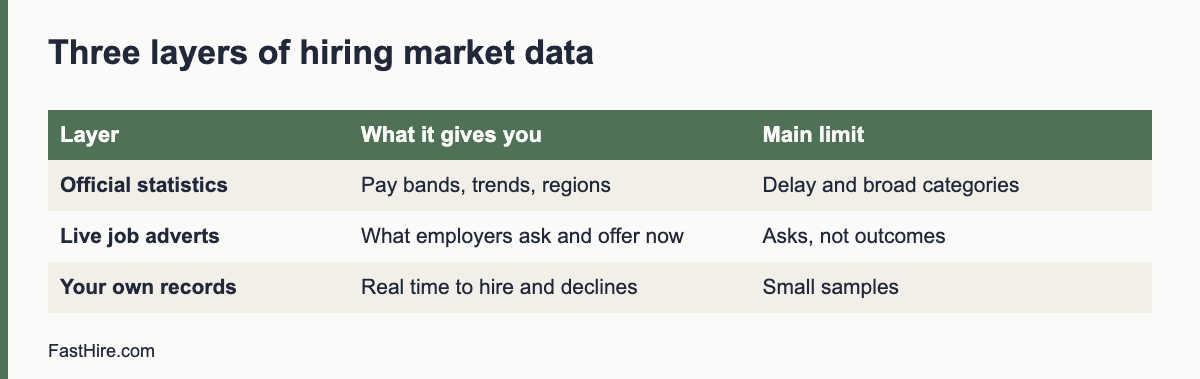
    The three layers of data

    LayerWhat it gives youLimits
    Official statisticsOccupation definitions, typical pay bands, employment trends, regional differences, labour market conditionsPublished with a delay; broad job categories; may not match your exact role or skills
    Live job advertsWhat employers ask for and offer now; titles used; location and remote rulesAdverts are asks, not outcomes; pay may be missing; duplicates inflate counts
    Your own recordsHow long searches took, where candidates dropped out, offer acceptance, reasons for declinesSmall samples; reflect your brand and process as well as the market

    No single layer is enough. When the three agree, you can be more confident. When they disagree, ask why. A role that official data shows as widely available but where your last two searches had few applicants may point to your advert, your pay or your location rules rather than the market.

    Where to look: official sources

    RegionSourceWhat you can find
    United StatesBureau of Labor Statistics Occupational Outlook HandbookJob duties, education, pay and outlook by occupation
    United StatesBLS Occupational Employment and Wage StatisticsWage estimates by occupation and area
    United StatesCareerOneStopOccupation profiles, wage and licence information, sponsored by the US Department of Labor
    United KingdomOffice for National Statistics: employment and labour marketEmployment, vacancies and earnings data
    United KingdomGOV.UK National Minimum Wage ratesLegal pay floors, not market rates
    European UnionEurostat labour market statisticsEmployment and unemployment data by country
    European UnionEURESLabour market information, mobility rules and vacancies across the EU

    These pages change, and the names of their datasets change too. Open the current page and read the notes on definitions and dates. Where a page offers pay by occupation, check the job definition. A “software developer” in a statistical table may cover a wider group than the role you are hiring.

    A step-by-step method: 45 minutes

    1. Define the role in words. Write the job in one sentence and list three must-have skills. Use plain titles, not internal ones.
    2. Find the official occupation. Use the occupation lists in the sources above. Note the code or name.
    3. Read pay and outlook. Note the pay range, the date and the area. Do not copy a single figure. Write “the page shows a range from X to Y for [area] in [year]” in your notes.
    4. Collect 10 live adverts. Search with three different job titles. Record title, location, remote rules, required skills and pay if shown. Remove duplicates.
    5. Compare requirements. Which skills appear in most adverts? Which appear in only one? This shows what the market treats as standard.
    6. Compare pay. If many adverts do not show pay, note that. Where pay laws require disclosure, the numbers will be easier to find; rules differ by place.
    7. Check your own records. For the last two similar searches, note applicants, time to hire and reasons for declined offers.
    8. Write a one-page summary. Three findings, two risks and two options.

    Reading the numbers carefully

    CheckWhy it matters
    Date of the dataPay and demand change. A figure from two years ago may be out of date.
    RegionNational averages hide local differences. Big cities and rural areas differ.
    DefinitionJob titles vary. Read what the category includes.
    Average or medianA median is closer to a typical case. An average can be pulled by a few high figures.
    Sample sizeSmall samples are unreliable. Look for a note.
    SourceIs it a government statistic, a company marketing report or an anonymous post? Weigh them differently.
    Full compensationPay, bonus, benefits and flexibility all matter to candidates.

    Be careful with salary reports from commercial sites. Some are useful, but many use self-reported data. Treat them as a clue and compare with official figures. Do not quote a figure to a manager without saying where it came from and when.

    What to ask about pay and the law

    Pay questions have legal sides. In several places, laws now ask employers to share pay ranges or to avoid asking for pay history. These rules differ across US states, the UK and EU countries, and they are changing. We cover them in our guide to pay transparency. Until then, check the official page for each place you hire, and do not set pay for a role by looking at a candidate’s past salary. Our guides on hiring in another country and the cost to hire an employee explain related costs.

    Turning findings into a conversation

    Share the summary in the first five minutes of the meeting. Use plain statements: “Official data shows a range of X to Y for this occupation in [area]. Of ten live adverts, seven offer more than our range. Our last two searches received [number] applicants.” Then ask, “What would you like to do?” Give two or three options. For example: raise the range, accept less experience and plan training, or extend the timeline. The manager decides.

    Mistakes to avoid

    • Treating one salary figure as the market. Always give a range and the source.
    • Copying competitors’ adverts. Use them to learn what the market asks for, not to copy their words or their requirements.
    • Ignoring supply. A role that needs rare skills in a small town needs a different plan, such as remote work or training.
    • Forgetting notice periods. Local norms differ. Ask candidates in the first conversation.
    • Skipping your own data. Your history is the most relevant evidence you have.

    FastHire is being built for the screening stage that follows the market check. It shows each job requirement next to the exact CV passage that supports it, so you can see how a requirement affects the pool of real applicants. FastHire is coming soon. It does not rank, score or reject candidates. People make every decision.

    A worked example (fictional)

    This example is invented to show the method. The numbers are not real market data. A recruiter prepares for an intake meeting on an accounts payable specialist role in a mid-sized city.

    StepFinding (invented)What the recruiter does with it
    Official occupationThe closest official category covers bookkeeping and accounting clerks, with a wide pay range for the regionNotes the range and the date, and writes down that the category is broad
    Ten live advertsEight ask for experience with a specific accounting system; three ask for a professional qualification; two show payMarks the system experience as common and the qualification as less common
    Pay in advertsTwo adverts show ranges that overlap the company range at the lower endNotes that the sample is tiny and that most adverts hide pay
    Own recordsThe last search received 38 applicants and took longer than planned because two offers were declined for pay reasonsPrepares an option to raise the range or to hire for potential
    Notice periodsTwo shortlisted candidates in the last search had long notice periodsAdds a start date range to the brief

    The recruiter then writes a one-page summary: three findings (system experience is standard, the qualification is not, pay was a reason for declines), two risks (the pay range is at the low end, start dates will be later than the manager hopes) and two options (adjust the range, or hire for core skills and train on the system). The manager sees facts and choices, and decides.

    A one-page market summary template

    SectionFill in
    Role and location
    Official source, date and range
    Number of live adverts reviewed and date
    Skills in most adverts
    Skills in few adverts
    Pay shown in adverts (range, number of adverts that show pay)
    Remote or hybrid norms
    Our last two similar searches: applicants, time to hire, reasons for declines
    Three findings
    Two risks
    Two options

    Keep the summary short and put the sources in a footnote or an appendix. If you repeat the exercise for the same role family each quarter, you will build a record that shows how the market changes and how your own results compare.

    Fairness and the law when you use market data

    • Use market data to set the role, not to filter people. Pay and skills data describes the market. It says nothing about any one candidate.
    • Do not set pay from a candidate’s earlier salary. Several places restrict asking about pay history. Check local rules.
    • Keep pay fair inside the company. Compare with people in similar roles so that the new offer does not create gaps that cannot be explained by job-related reasons.
    • Be careful with scraped data. If you collect candidate data from public sources, GDPR and other laws still apply. See GDPR for job applicants.

    Keeping the research current

    Market data ages quickly, so build a light routine. Once a quarter, update your summary for the three roles you hire for most often. Re-check ten adverts for each, note any change in pay or requirements, and add the results of your own searches from the last quarter. Store the summaries in one folder with the date in the file name. When a manager asks “what is the market doing?” you can answer in a minute with a document that shows its sources.

    Also keep a short list of questions that the data cannot answer, such as why strong candidates declined or how your brand is seen. Collect that information through direct conversations with candidates, using a short, neutral question at the end of the process. Numbers describe the market. Conversations explain your place in it.

    One last habit: write down what the data cannot tell you. Official statistics do not show how candidates feel about your brand, how fast your competitors move or how a new law may change pay in the next year. List these unknowns in your summary and say how you will learn about them, for example through candidate comments, calls with other recruiters or a short test of a revised advert. Being clear about limits makes the rest of the summary more credible with hiring managers.

    Frequently asked questions

    Which source is best for pay data?

    Official statistics are the most reliable for context, but they are broad. Use them with live adverts for your area and your own offers and declines.

    How often should I check the market?

    Before each new role, and every few months for roles you hire for often.

    What if there is no data for my role?

    Use the closest occupation, compare with adverts for related roles and talk to hiring managers and recruiters in other teams. Say that the data is limited.

    Can I use LinkedIn or job boards for data?

    They can show live adverts and titles. Be aware that their data is not a full or neutral sample of the labour market.

    Should I share market data with candidates?

    You can share the pay range for the role. Do not share other candidates’ data or private offers.

    Related guides

    This is general information, not legal advice.
  • Disparate treatment vs disparate impact in hiring

    Disparate treatment vs disparate impact in hiring

    In US law, disparate treatment means treating a person worse because of a protected characteristic, such as race, sex or religion. Disparate impact means using a neutral rule or test that excludes members of a protected group at a much higher rate and is not job-related and necessary. Treatment is about intent and motive. Impact is about the effect of a neutral practice.

    Key takeaways

    • Disparate treatment: different treatment because of a protected trait. Proof often looks at motive or evidence of different rules for different people.
    • Disparate impact: a neutral practice with an uneven effect that the employer cannot justify as job-related and consistent with business necessity.
    • Both apply to hiring: ads, screening, tests, interviews and offers.
    • The UK and EU use the terms direct and indirect discrimination for similar ideas.
    • US enforcement priorities on disparate impact have shifted. Check current official guidance. This is general information, not legal advice.
    x

    The two theories in plain words

    Think of two questions. First: did you treat this person differently because of who they are? That is disparate treatment. Second: does one of your rules, which looks the same for everyone, produce a very uneven result that you cannot justify by the needs of the job? That is disparate impact.

    Disparate treatmentDisparate impact
    Core questionWas a person treated worse because of a protected trait?Does a neutral rule cause a much worse result for a protected group?
    FocusMotive and different rules for different peopleEffect of one practice on a group
    Example in hiringA manager refuses to interview women for a night shift role because “women should not work at night”A strict lifting test that nobody needs for the job and that most women fail
    What the employer must showA legitimate, non-discriminatory reason, not a pretextThat the practice is job-related and consistent with business necessity
    Evidence often usedStatements, patterns, comparisons with similar candidatesStatistics, such as selection-rate comparisons, and validation of the practice
    Intent needed?Yes, in the sense of acting because of the traitNo

    The US Equal Employment Opportunity Commission explains protected traits and practices to avoid on its page about prohibited employment policies and practices. The EEOC page on employment tests and selection procedures describes disparate impact in testing. The text of Title VII of the Civil Rights Act of 1964 is on the EEOC website.

    Disparate treatment in hiring: examples

    • An ad that says “young team, digital natives” and a manager who rejects older applicants because of age.
    • A recruiter who sends different interview questions to women than to men for the same role.
    • A hiring manager who does not shortlist an applicant after learning that the applicant is pregnant.
    • A rule that is applied to some groups and not others, such as asking only certain candidates for extra references.
    • A decision to avoid a candidate because customers might prefer someone else of a different race or sex. Customer preference is generally not an acceptable reason.

    Notice that these examples may be proven by documents, messages, interview notes and patterns. This is why recording job-related reasons for each decision matters. See our guide to documenting hiring decisions and the steps in how to reduce bias in resume screening.

    Disparate impact in hiring: examples

    • A strict height or weight rule that is not needed for the job and screens out more women than men.
    • A requirement for a four-year degree where the work does not need one, which may exclude some groups at a higher rate.
    • A keyword filter that rejects applications with certain gaps or formats, with an uneven effect on a group.
    • An aptitude test not validated for the job, with a large difference in pass rates by group.
    • A rule that excludes anyone with any criminal record regardless of the offence, the time elapsed and the job. Rules vary by place.

    In each example the rule looks neutral. The concern is the result and the lack of job-related justification. For how to measure results, see the four-fifths rule explained.

    The legal background in the US

    The disparate impact theory comes from the US Supreme Court case Griggs v. Duke Power Co., decided in 1971, which held that employment practices that are neutral on their face but operate to exclude a protected group can violate Title VII if they are not related to job performance. Congress later wrote the disparate impact standard into Title VII in the Civil Rights Act of 1991 (section 703(k)). Under that section, a plaintiff can show that an employer uses a particular practice that causes a disparate impact on a protected basis, and the employer must then show that the practice is job-related for the position and consistent with business necessity. The plaintiff may still prevail by showing a less discriminatory alternative that the employer refused to adopt.

    Enforcement priorities have changed. In April 2025 an executive order directed federal agencies to deprioritise enforcement of disparate-impact liability. The statute itself remains, private lawsuits may still use it, and state and local laws may apply their own rules. Because this area is moving, check the latest EEOC guidance and your state law, and take advice for any decision with legal risk.

    The same ideas in the UK and EU

    RegionTreatment-like conceptImpact-like conceptWhere to read
    United KingdomDirect discrimination: treating someone less favourably because of a protected characteristicIndirect discrimination: a provision, criterion or practice that puts people sharing a characteristic at a particular disadvantage, which the employer cannot show to be a proportionate means of achieving a legitimate aimAcas: recruitment
    European UnionDirect discrimination in the equal treatment directivesIndirect discrimination in the same directives, with a justification testDirective 2000/78/EC; Directive 2000/43/EC; national law
    United StatesDisparate treatmentDisparate impactEEOC

    The ideas are similar but not identical. Do not assume that a defence that works in one country works in another. For example, the UK test asks whether the practice is a proportionate means of achieving a legitimate aim, while the US test asks about job-relatedness and business necessity. Use local guidance for each country where you hire.

    What this means for your hiring process

    RiskControl
    Treating people differently because of a traitSame questions, same criteria, same time, written scoring, second reviewer on a sample
    Neutral rules with uneven resultsWrite criteria from the tasks of the job, avoid unneeded filters, monitor selection rates where lawful
    Decisions that cannot be explainedRecord evidence and reasons for each decision
    Biased or untested toolsAsk vendors how tools were tested; test on your data; keep people in charge
    Unclear requirementsUse checkable requirements. See how to write checkable job requirements

    A worked example (fictional)

    This example is invented. A warehouse employer adds a rule: all applicants must lift 40 kilograms unaided. A review shows that the actual job uses mechanical aids for loads above 15 kilograms. The lifting rule, applied to everyone, screens out far more women than men. There is no evidence of anyone intending to exclude women, so this is not disparate treatment. It may be disparate impact because the rule is neutral on its face, has an uneven effect and may not be job-related. The employer reviews the job tasks, sets a lifting requirement based on the tasks, and offers a trial of the aids. It tests the new requirement for selection rates. Separately, a manager tells one female applicant “this is not a job for a woman”. That is disparate treatment, and the employer would need to address it as a conduct issue, with HR and legal advice.

    Practical checklist

    • Every requirement is linked to a task in the job description.
    • Requirements are the same for everyone.
    • Tests are validated for the job, or you have evidence they relate to the work.
    • Selection rates are checked where lawful.
    • Managers are trained on what not to say or ask. See what you can and cannot ask.
    • Reasons for decisions are written down.
    • Complaints have a clear route and are taken seriously.

    How to test a practice for job-relatedness

    If a rule is flagged for uneven results, you need to show how it relates to the job. A practical method has five steps. This is a general approach, and a specialist can help with formal validation.

    1. Describe the job tasks. Use a current job analysis or a detailed description written with people who do the work.
    2. Link the rule to a task. For each requirement, write the task that needs it and how often the task occurs.
    3. Check how the requirement is measured. A test of a skill should reflect the skill in the real job, not a broader or different one.
    4. Look for evidence. Past performance data, expert review or published validation studies can show that the rule predicts performance.
    5. Look for alternatives. Could another method measure the same skill with less effect on a group? Try it on past data if possible.

    Record each step. If you cannot link a requirement to a task, remove it or change it. A requirement that is a habit or a status marker is the most likely to fail.

    Training managers on the difference

    Short training works best when it uses real cases. Give managers three one-paragraph scenarios and ask them to label each as treatment, impact or neither, and to say what they would change. Discuss the answers for 20 minutes. Repeat once a year. Include these points: do not decide on protected traits, apply the same rules to everyone, ask whether a rule is needed for the job, and escalate concerns early. For managers who interview, share the guide on questions you cannot ask.

    When to ask for advice

    • You see a large gap in selection rates and cannot explain it by job-related reasons.
    • A candidate or employee complains about unfair treatment.
    • You plan to use a new test or tool for many applicants.
    • You operate in several countries with different rules.
    • A manager made a comment that suggests a decision was based on a protected trait.

    In these cases, bring in HR and a qualified employment lawyer early. Keep records, avoid deleting documents and do not contact the complainant in a way that could be seen as pressure. Take the issue seriously and respond promptly. This is general information, not legal advice.
    Remedies and risks, in brief

    If a court or agency finds discrimination, remedies can include changes to the practice, back pay, compensation and legal costs. The exact remedies depend on the law and the country. Besides legal risk, there is reputation risk and the loss of talent. A fair, evidence-based process lowers both. It is also cheaper to fix a rule early than to defend it later. Review your criteria, tests and tools once a year, and each time you change a requirement. Keep the review short and written.

    Frequently asked questions

    What is the difference between disparate treatment and disparate impact?

    Treatment is about treating a person worse because of a protected trait. Impact is about a neutral practice that has a much worse effect on a protected group and is not justified by the job.

    Do I need intent for disparate impact?

    No. The focus is the effect of the practice and whether it is job-related and necessary.

    Are these terms used in the UK?

    The UK uses direct and indirect discrimination, which are similar but follow different tests.

    Can a neutral test be lawful if it has an uneven effect?

    In the US, it may be if the employer shows it is job-related and consistent with business necessity and no less discriminatory alternative exists. Take advice.

    Has US enforcement of disparate impact changed?

    Federal priorities shifted in 2025. The statute remains and private and state actions may apply. Check current official guidance.

    Related guides

    This is general information, not legal advice.
  • EU equal treatment rules in hiring: what employers should know

    EU equal treatment rules in hiring: what employers should know

    EU equal treatment rules for hiring come from several directives that each member state turns into national law. They ban discrimination in access to employment, including recruitment, on grounds of racial or ethnic origin, religion or belief, disability, age, sexual orientation and sex. Because national laws differ in detail, employers must check the law of each country where they hire.

    Key takeaways

    • EU directives set minimum rules. Each country adds its own law, so details differ.
    • Protected grounds in employment: racial or ethnic origin, religion or belief, disability, age, sexual orientation, and sex.
    • Direct and indirect discrimination, harassment and instructions to discriminate are covered.
    • Employers must provide reasonable accommodation for disabled people, unless it creates a disproportionate burden.
    • When a person shows facts that suggest discrimination, the burden of proof can shift to the employer.
    x

    How EU law works for employers

    The European Union does not have one employment law that applies directly to every employer. Instead, it issues directives. A directive sets a goal, and each member state writes national laws to meet it. Member states can set higher protection. That is why an employer in Ireland, Germany, Spain and Poland may face different details on the same topic. Always read the national law and guidance for the country where the job is based, and where the employer is established.

    This guide gives an overview. It is general information, not legal advice. For official summaries, see the Your Europe page on hiring and managing staff.
    The main directives

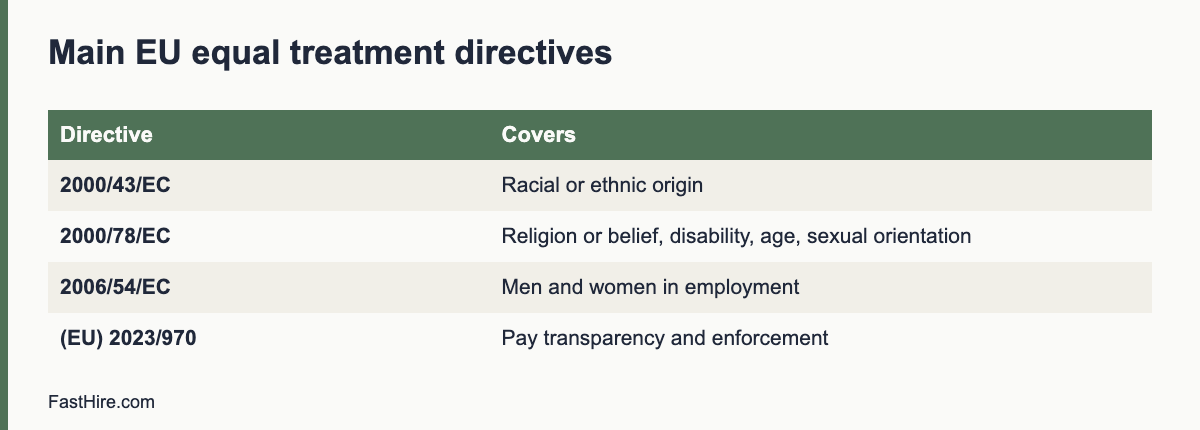
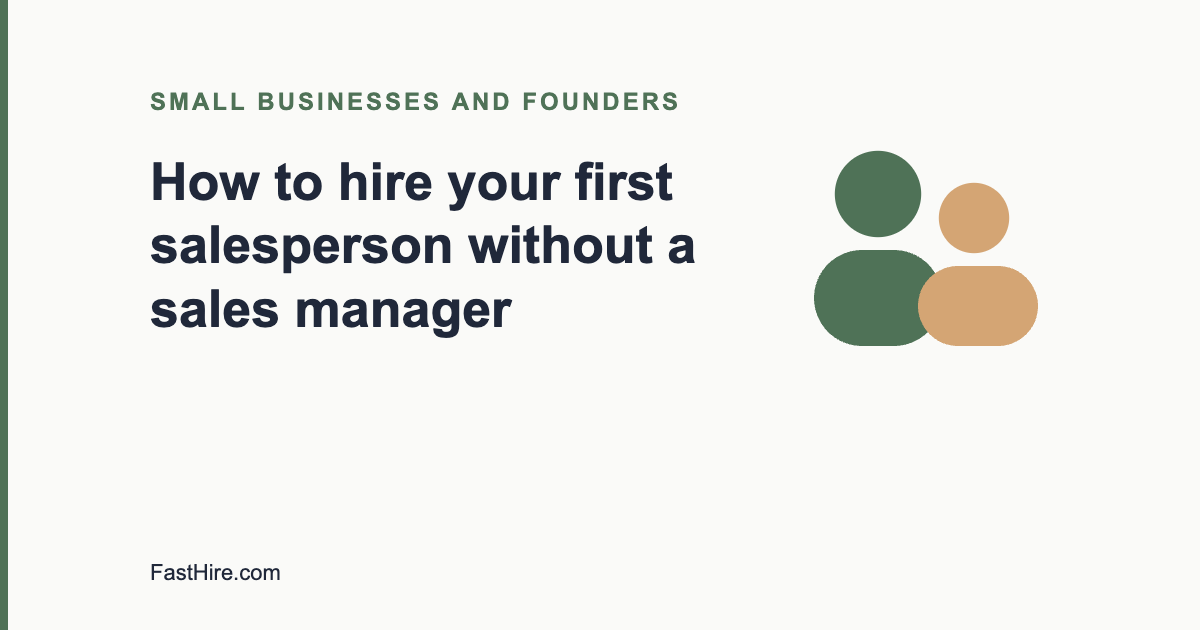
    DirectiveWhat it coversOfficial text
    Directive 2000/43/EC (Racial Equality Directive)Equal treatment irrespective of racial or ethnic origin, including access to employment, in the public and private sectorsEUR-Lex
    Directive 2000/78/EC (Employment Equality Directive)Equal treatment in employment and occupation on grounds of religion or belief, disability, age and sexual orientationEUR-Lex
    Directive 2006/54/EC (Recast Directive)Equal opportunities and equal treatment of men and women in matters of employment and occupationEUR-Lex
    Directive (EU) 2023/970 (Pay Transparency Directive)Pay transparency and enforcement mechanisms, with duties that include information for job applicants about pay. Member states must apply it through national lawEUR-Lex

    The EU Charter of Fundamental Rights also includes a ban on discrimination. Member states and EU institutions must respect it when applying EU law. For the application date of national pay transparency rules, check the official national implementation and the EUR-Lex record, because dates and details may vary by country. We do not give a date here.

    What counts as discrimination

    ConceptMeaningRecruitment example (fictional)
    Direct discriminationA person is treated less favourably than another in a comparable situation because of a protected groundAn ad that says “no applicants over 40”
    Indirect discriminationAn apparently neutral provision, criterion or practice puts people with a protected ground at a particular disadvantage, unless it is objectively justified by a legitimate aim and the means are appropriate and necessaryA rule that all staff must work on a day of religious observance, with no need
    HarassmentUnwanted conduct related to a protected ground that violates dignity and creates an intimidating, hostile, degrading, humiliating or offensive environmentInsulting comments in an interview
    Instruction to discriminateTelling someone to discriminateA manager telling a recruiter to remove applicants of a certain origin
    VictimisationAdverse treatment for complaining or supporting a complaintRefusing to hire a person who earlier made a complaint

    These definitions are paraphrased from the directives. Read the directive and your national law for exact wording. The tests for justification differ between grounds and countries.

    Reasonable accommodation for disabled people

    Under Directive 2000/78/EC, employers must take appropriate measures, where needed in a particular case, to enable a person with a disability to have access to employment, to take part in it, to advance, or to undergo training, unless the measures would impose a disproportionate burden. In recruitment, this can mean accessible application formats, adjusted tests, extra time, accessible premises, assistive technology or a modified interview format. State how applicants can ask for adjustments in the job ad and the invitation. Respond quickly and record what you agree. National law may define “disability” and “disproportionate burden” in detail. See our UK guide on reasonable adjustments for a comparison.

    Exceptions: genuine occupational requirements

    The directives allow limited exceptions. A difference of treatment based on a characteristic related to a protected ground may be lawful where, because of the nature of the occupational activities or the context, the characteristic is a genuine and determining occupational requirement, the objective is legitimate, and the requirement is proportionate. Churches and organisations with an ethic based on religion or belief have some defined flexibility under Directive 2000/78/EC, within limits set by national law. Age differences can be justified in some cases, such as set minimum age for safety-critical work, if objectively and reasonably justified by a legitimate aim. These exceptions are narrow. Do not rely on them without advice.

    Burden of proof and enforcement

    The directives require that when a person shows facts from which discrimination may be presumed, the respondent must prove that there was no breach of the principle of equal treatment. This is called the shifting of the burden of proof. It does not mean a complaint wins automatically. It means that you must be able to show job-related reasons. Written criteria, scorecards and records make this possible.

    Member states must provide ways to enforce the rules, including judicial or administrative procedures, and penalties that are effective, proportionate and dissuasive. Many countries have an equality body that gives advice and support to people who think they were discriminated against. The remedies and procedures differ between countries.

    What to do in recruitment, step by step

    1. Identify the countries. List where the job is based and where you are established.
    2. Find national guidance. Look for the equality body, the labour ministry and the data protection authority for each country.
    3. Write job-related criteria. Link each requirement to a task. See must-haves vs nice-to-haves.
    4. Use neutral ads. Avoid wording that signals age, sex, origin or religion without a genuine need.
    5. Use structured screening and interviews. Same criteria, same questions. See structured screening.
    6. Offer accommodations. Invite applicants to ask for them.
    7. Keep records. Store scorecards and reasons securely and delete them on schedule.
    8. Check data rules. Monitoring data about protected grounds is special category data under GDPR, with extra rules. See the GDPR text and your national authority, or the European Data Protection Board.

    Differences across countries: what to check

    TopicWhy it variesWhat to check
    List of protected groundsMany countries add grounds such as language, family status, social origin or political opinionThe national equality act and guidance
    Age rulesMinimum ages, retirement rules and justifications differNational labour law
    Questions about criminal recordsRules differ widelyNational law and data protection authority
    Health questionsStrict in many countriesNational law on pre-employment medical questions
    Photos and personal details on CVsCustoms differ; some countries discourage or restrict themNational guidance
    Monitoring and diversity dataSpecial category data; some countries restrict collecting itData protection authority
    Collective agreementsMay add duties in some sectorsSector agreements

    When you recruit across several countries, build a short country sheet for each: protected grounds, key rules, who to contact and the process notes. Update it once a year. See our guide to managing hiring across the US, UK and EU for an approach to multi-country work.

    A worked example (fictional)

    This example is invented. A company based in one EU country opens a role in another member state. The HR lead assumes that the same ad and interview questions apply. She checks national guidance for the second country. She finds that the local equality body discourages questions about marital status and that photos on CVs are not required. She removes a line about “native speaker” from the ad and replaces it with “fluent written and spoken French at a level for client calls”, which she can test in a call. She adds an adjustments line in the local language. She tells the interviewers which topics are not allowed. The process is the same in structure as in the home country and different in details. She keeps a one-page note of what she checked, with sources and the date.

    Job ads under EU equal treatment rules

    The job ad is the first place where discrimination can occur. Many countries ban ads that exclude people on a protected ground unless there is a genuine occupational requirement. Use this short check before you publish.

    CheckExample of a riskBetter wording
    Age“Young and dynamic team”; “recent graduate” with no need“Team that values learning”; “entry-level; training provided”
    Sex“Salesman wanted”; “waitress”“Sales representative”; “server”
    Origin“Native speaker”“Fluent written and spoken [language] (level B2 or equal)”
    Religion“Must be available on all religious holidays”State the real schedule
    Disability“Must be fit and healthy”“This role includes [tasks]. Tell us if you need adjustments.”
    Family“No family commitments”State the hours and the place

    The language level scale in the table (B2) refers to the Common European Framework of Reference for Languages, which many employers use. State the level only if the job needs it.

    Working across several member states

    If you run one process for several countries, keep a shared core and adapt local details. The core can be the criteria, the scorecard and the evidence sheet. The local details are the ad wording, the legal checks, the data rules and the questions you must avoid. Appoint a local contact, such as an HR adviser or a lawyer, for each country. Ask them to review your template once a year and when laws change. Share a short summary with all interviewers, in the local language where possible.

    Be careful with tools and vendors. If you use software for screening or testing, ask where data is stored, how long it is kept and whether the tool was tested for unfair effects. In the EU, rules on automated decisions and on the use of AI in hiring may also apply. Check the official EU sources and your national authority. This is general information, not legal advice.

    Records that help you in a dispute

    Because the burden of proof can shift, records matter. Keep the role brief and criteria, the ad as published, the question list, the scorecards, the notes, the decision record and the messages sent to candidates. Store them securely, limit access and set a deletion date that follows national law and data protection rules. If a complaint arrives, do not delete or change records. Keep them, tell your legal adviser and respond within the time that applies.

    A short, written explanation for each hiring decision, linked to the criteria, is often the strongest evidence of fair treatment. It also improves your own decisions, because writing the reason forces you to check it. Make this habit part of your debrief. See how to run a debrief meeting for a template of a decision record.

    Frequently asked questions

    Which grounds does EU law protect in employment?

    Racial or ethnic origin, religion or belief, disability, age, sexual orientation and sex. National laws often add more.

    Do EU directives apply directly to employers?

    They are implemented through national law. Employers follow the national law of the country where they hire.

    Do I have to provide reasonable accommodation?

    Yes, for disabled applicants and employees, unless it would impose a disproportionate burden. National law sets the details.

    What does a shifting burden of proof mean?

    If a person shows facts that suggest discrimination, the employer must prove it did not breach equal treatment. Records help you do that.

    Where can I find the national rules?

    Start with the Your Europe pages, then the equality body, labour ministry and data protection authority of the country concerned.

    Related guides

    This is general information, not legal advice.

  • How to hire your first salesperson without a sales manager

    How to hire your first salesperson without a sales manager

    To hire your first salesperson without a sales manager, first write down how you win customers today, then hire for the exact job: who the person will sell to, what they will sell, how they will find leads and how you will measure results. Test the skill with a realistic role-play and a short plan, keep pay simple, and set clear targets and a review date.

    Key takeaways

    • Document your own sales process before you hire. A salesperson cannot copy what is only in your head.
    • Define the job type: finding new customers, growing existing ones, or both.
    • Test the skill with a realistic role-play and a 30-day plan, not only with an interview.
    • Keep pay simple: a base plus a clear, written commission or bonus plan.
    • Plan onboarding and weekly coaching. A first salesperson without a manager needs structure from you.
    x

    Why the first salesperson is hard to hire

    A founder usually makes the first sales through personal contacts, passion and trial and error. A salesperson cannot copy that. If you do not explain who buys, why they buy, what you say and what happens next, the new person will invent a process and you will not know if it works. Without a sales manager, the founder is the manager, and the risk is high: a wrong hire costs months of pipeline time. Read our guide on what a bad hire really costs for a way to estimate that risk.

    This guide gives a seven-step method. It does not promise results and uses no sales statistics, because outcomes depend on your product, market and price.

    Step 1: Write down how you sell today

    Spend two hours and fill in this sheet. If you cannot answer a row, that gap is part of the job to hire for.

    QuestionYour answer
    Who buys? (role, company type, size)
    What problem do they have when they call you?
    Where do your best customers come from?
    What do you say in the first call?
    What are the common objections, and your replies?
    How long from first contact to a decision?
    What is your price, and how flexible is it?
    What do you promise, and what do you not promise?
    What happens after the sale?

    Step 2: Define the role type

    TypeMain taskSkills to testTypical risk
    New-business seller (hunter)Find and win new customersProspecting, cold outreach, resilience, pipeline habitsBurnout if leads are weak or the product is not ready
    Account seller (farmer)Grow existing customersRelationship care, upselling, serviceMay not find new leads
    Inside sellerSell by phone or videoClear speaking, listening, notesNeeds a good lead source
    Field sellerVisit customersPlanning, travel, local knowledgeHigher cost; harder to coach
    HybridBoth new and existingAll of the aboveRole may be too wide for one person

    Choose the type that matches your next 12 months. If you have more leads than time, hire for conversion. If you have few leads, hire for prospecting and decide how you will support lead generation.

    Step 3: Set a realistic target and pay

    Estimate a target from your own data: the average deal value, the number of deals you win in a month, and how many you could handle together. Do not copy a quota from the internet. Set the target for the first 90 days as activity and learning goals, such as number of qualified conversations and number of proposals, and set revenue targets from month four. A fair plan has three parts: a base salary, a variable payment and a clear rule for how the variable is calculated.

    ItemWhat to writeWhy
    BaseA fixed amount that allows the person to live without sales in the first monthsReduces desperation and bad selling
    VariableA percentage of revenue, a fixed amount per deal or a bonus on a targetAligns pay with results
    What countsWhich deals, when they count (signed, paid, delivered)Prevents disputes
    Cap or no capState clearlyAvoids surprise
    TimingWhen commission is paidCash flow clarity
    ChangesHow and when you can change the plan, with noticeFairness

    Put the plan in writing, in plain words. Check the law on pay in your country: in the US see the Department of Labor wage pages; in the UK, commission can affect holiday pay, see GOV.UK holiday entitlement; in the EU, national rules apply. Use the cost worksheet to price the full cost. This is general information, not legal advice.
    Step 4: Write an honest job ad

    Say what you sell, who buys, how leads arrive, what you offer as support and what the pay looks like. Candidates distrust vague promises such as “unlimited earnings”. Describe the real average setup in words, with no invented numbers. See how to write a job ad that attracts the right applicants.

    Step 5: Screen and interview for evidence

    Use a structured interview. Ask for past examples and numbers the candidate can explain. Verify them in references.

    AreaQuestionWhat a strong answer shows
    ProcessWalk me through the last deal you won, from first contact to signature.Clear steps, what they did, what they learned
    ProspectingHow did you find new leads in your last role? Which methods worked and which did not?Methods, effort, honesty about results
    ObjectionsTell me about a time a prospect said no. What did you do next?Resilience and listening
    TargetsWhat target did you have, and what did you reach? How did you plan your month?Real figures they can explain; planning
    Fit with a small companyWhat will you do when there is no marketing team or sales manager to help?Self-direction, simple tools
    EthicsTell me about a time you decided not to make a sale. Why?Honesty and long-term thinking

    Use the same questions for every candidate and score with a scale. Our guides on structured interviews and the first interview show how. Avoid questions on protected traits. See what you can and cannot ask.

    Step 6: Run a role-play and a 30-day plan

    A work sample shows the skill. Give finalists a made-up product or your real product description and 20 minutes to prepare. Then play a prospect for 15 minutes. Score on a written guide: discovery questions, listening, handling an objection, clear next step. Ask them to send a one-page plan for their first 30 days. Do not ask for free real work, such as calling your real prospects. See how to run a work sample test for fair design and pay rules.

    Step 7: Check references and decide

    Ask referees for facts: the role, the targets, the results, the way the person worked with others. Check numbers that the candidate gave. A reference from a former manager is more useful than a friend. See how to check references.

    Onboarding a salesperson without a sales manager

    You are the manager, so plan your time. Block weekly one-hour coaching and a short daily check-in in the first month.

    WeekFocusOutput
    1Product, customers, your sales sheet from step 1, shadow your callsPerson can explain the offer and the buyer in five minutes
    2Role-play with you, review of past deals, tools set upPerson makes first outreach with your review
    3First calls and meetings with you listeningPipeline sheet started
    4Weekly plan and numbers; review what works30-day review and plan for the next 60 days

    Add a simple tracking sheet for leads, conversations, proposals and decisions. Review it weekly. Use the sheet to coach, not to blame. See the first 30 days onboarding plan.

    Mistakes to avoid

    • Hiring a salesperson before you have a repeatable way to find leads or an offer you can explain.
    • Promising a lead flow that does not exist.
    • Paying only on commission for a new product with no brand. This transfers all the risk to the person and can attract the wrong applicants. Check legal minimum pay rules, which apply in many countries.
    • Setting a target from a competitor’s numbers, not your own.
    • Choosing the most charming candidate without evidence of results.
    • Leaving the person alone for a month with no feedback.

    Be fair and honest. A salesperson who leaves because the job was misdescribed leaves a gap and a story in the market. A clear, honest process protects both sides.

    A worked example (fictional)

    This example is invented. A founder of a small software company sells to dental clinics. She documents her process: she finds clinic managers through a local association, calls them, runs a 20-minute demo and sends a proposal. She decides to hire a new-business seller with a base salary and a commission on signed annual contracts. She writes an honest ad and interviews six people with the same questions. Two finalists do a role-play: a dental clinic manager who worries about data privacy. One finalist asks discovery questions and offers a next step. The other talks about features for ten minutes. The founder scores the first higher. References confirm the finalist’s story. In the first month the founder spends one hour each week on coaching, and reviews the lead sheet. After 90 days they review activity numbers, not only revenue, and adjust the plan.

    A 30-60-90 day plan for the new salesperson

    PeriodGoals (activity and learning)Review question
    Days 1 to 30Learn the offer and buyer; shadow five of your calls; make first outreach with review; set up the lead sheetCan the person explain the offer and the buyer clearly, and do they use the sheet every day?
    Days 31 to 60Run own calls; book a set number of qualified conversations; send first proposals; weekly role-play on objectionsAre the conversations qualified, and which objection comes up most?
    Days 61 to 90Close first deals with your support; improve the script from real calls; plan the next quarterWhat changed in the script, and what is the first revenue signal?

    Set the number of conversations and proposals from your own data and your sales cycle. Do not copy numbers from the internet. Review the plan together at day 30, 60 and 90, and write down what you agreed. If the person is not meeting the plan, give specific examples and support early. If you have a probation period, explain how the reviews relate to it. See probation rules by country in the offer guide for the basics.

    What to measure

    • Activity: conversations held, meetings booked, proposals sent. These show effort and habit.
    • Quality: share of conversations that match your target buyer; reasons for lost deals.
    • Outcome: deals won and their value, once the sales cycle allows.
    • Learning: changes made to the script and the lead sheet.

    Review activity and quality weekly. Review outcomes monthly. Be cautious with a single month’s revenue, because small samples are noisy. If you have only a few deals a quarter, one deal changes the picture a lot. Use a longer window and the reasons for lost deals.

    Fairness in a commission plan

    Use clear rules and apply them to everyone. Do not change the plan retroactively. If you hire more than one salesperson, define how territories and leads are shared, so that the person with better leads does not earn more for the same effort. Avoid unlawful deductions from pay, and take advice on how clawbacks and caps are treated in your country. Keep records of targets and payments.

    Frequently asked questions

    Should my first salesperson be paid only on commission?

    Often a mix is fairer. Many countries have minimum pay rules that apply regardless of commission. Pure commission transfers all risk to the person and can attract the wrong applicants.

    Can I hire a salesperson before I have sales systems?

    You can, but write down your process first. Without it, the person cannot repeat what works.

    How long until a new salesperson produces results?

    It depends on your sales cycle. Set expectations from your own cycle length, not from general claims.

    What if I am not a good sales manager?

    Start with a simple weekly routine: review the lead sheet, listen to calls and role-play. Consider an advisor or mentor with sales experience.

    Should I hire an agency or freelancer first?

    It can be a lower-risk way to test the channel. See employee or contractor for the rules on status.

    Related guides

    This is general information, not legal advice.
  • How to hire in another country: a first guide for small employers

    How to hire in another country: a first guide for small employers

    To hire an employee in another country, first confirm why the role must be in that country, then choose a legal route: hire directly through a local company, use an employer of record, or engage a contractor if the facts support it. Check local employment law, tax and social contributions, right to work, data protection and company registration rules with a local adviser before you make an offer.

    Key takeaways

    • Employment law, tax and social contributions follow the place where the person works, and often where they live. Your home rules do not travel with the job.
    • There are three main routes: your own local entity, an employer of record, or a contractor. Each has costs and risks.
    • A person working for you in another country can create tax and legal duties for your company, even with no office.
    • Check right to work, data protection and pay rules before you recruit, not after.
    • Take advice from a local employment lawyer and accountant for the first hire.
    x

    Start with the reason and the facts

    Hiring abroad is more complex than hiring at home. Before you start, write down why. Reasons may include access to skills, serving customers in that market, time-zone cover or a person you already know who is moving. Then collect the facts: the country, the city or region, the job, the hours, whether the person will work remotely or on site, the expected length, and whether the person already has the right to work there.

    These facts decide which rules apply. Hiring a person who lives in Germany and works remotely for a US company is a different case from hiring a person in Poland to work in your Polish office. Always check the country-specific rules, because EU countries differ from each other as well. For an overview of EU staff rules, see Your Europe: hiring and managing staff.

    Three routes, compared

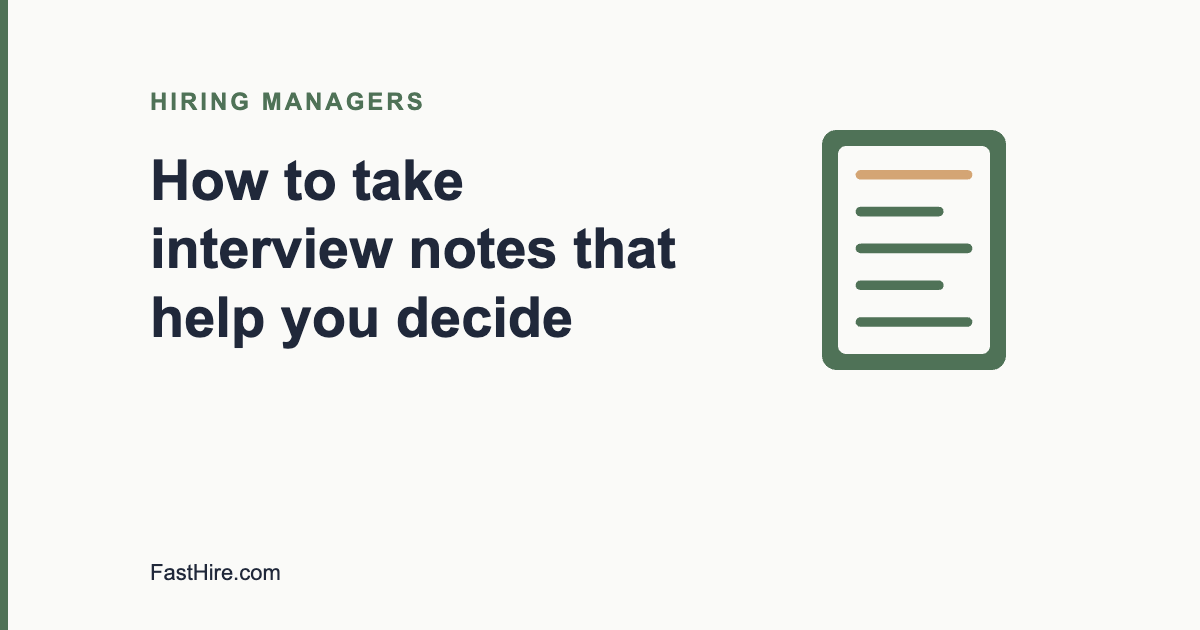
    RouteWhat it meansFits whenMain risks
    1. Your own local entityYou register a company or branch in the country, run local payroll and employ the person directlyYou plan several hires or a long-term presenceSet-up time and cost; local compliance; accounting and legal fees
    2. Employer of record (EOR)A local company becomes the legal employer and runs payroll and compliance; you direct the daily workYou want one or a few hires without setting up a companyFees; the contract with the provider matters; check what the provider does and does not cover; some tax risks may remain with you
    3. ContractorThe person works as a self-employed business and invoices youThe work is a defined project and the person is independent in factMisclassification: if the person works like an employee, authorities may treat them as one. See employee or contractor

    Do not choose a route only on price. A cheaper route that breaks the law costs more later. Ask a local adviser which route is lawful for your facts. In some countries, a remote employee can create a taxable presence, called a permanent establishment, for the employer. This is a tax question, and tax advisers can assess it.

    The seven checks before you recruit

    CheckQuestionWhere to look
    1. Employment lawWhat minimum terms apply: notice, probation, working time, holiday, sick pay, termination rules?National labour law and official portals; a local lawyer
    2. ContractDoes the contract need to be in the local language, follow a standard form, or include specific clauses?Local lawyer
    3. Tax and social contributionsWhat payroll tax and social contributions apply to the employer and employee? Who registers and files?National tax and social security authorities; an accountant
    4. Right to workDoes the person have the right to work in that country? If not, can you sponsor them?National immigration authority. See right to work basics
    5. Data protectionWhere will you store applicant and employee data? Are transfers across borders allowed?Data protection authority. In the EU, see the GDPR text and the EDPB
    6. Pay rulesIs there a legal minimum wage or collective agreement that sets minimum pay in the sector?National ministry of labour; sector agreements
    7. Insurance and benefitsWhich benefits are legally required, and which are common?Local adviser

    Many countries require pay transparency in job ads or have rules on how you can ask about salary history. Check these before you write the ad. See also our guide on what you can and cannot ask and note that rules differ by country.

    Step by step: your first international hire

    Step 1: Write the role brief

    Use the one-page role brief. Add: the country, the working hours and time-zone overlap, the language level needed and why, and the plan for supervision.

    Step 2: Choose the route and the advisers

    Ask a local employment lawyer and an accountant for a short written opinion on the three routes for your facts. Ask: what are the legal minimums, what will the first-year cost be, and which risks remain with us? If you use an EOR, ask for the contract, the fee structure, the data protection terms and a list of what the provider handles.

    Step 3: Estimate the full cost

    Use the cost worksheet, with local figures from official sources. Add: employer taxes and contributions, local benefits, advisor fees, EOR or entity fees, equipment, travel and currency costs. Do not copy rates from another country.

    Step 4: Write the ad in the local context

    Use plain language, the correct local job title, pay information where required, and the local language if the job needs it. Check local rules on ads and the words you must avoid. Post on local channels as well as global ones. See where to post a job when you have no budget. The EU job portal EURES supports cross-border job search in the European Economic Area.

    Step 5: Run a fair process

    Use the same structured process for all candidates: written criteria, structured interviews, a scorecard and references. Offer interviews at fair times across time zones and offer adjustments. Remember that questions allowed in one country may be restricted in another. Use the stricter standard when unsure.

    Step 6: Make a local-law offer

    Issue the offer and the contract in line with local law. Include: the legal employer, job title, place of work, pay, hours, notice, probation if allowed, holiday and benefits. Have the local lawyer review the contract. See how to make a job offer for the structure.

    Step 7: Onboard with the local rules in mind

    Complete required registrations before day one. Provide equipment and safety information for the place of work, even if remote. Plan regular check-ins and clear working hours. See the onboarding plan and add time-zone and culture notes.

    Common mistakes

    MistakeRiskFix
    Paying a person abroad as a contractor when they work like an employeePenalties, back taxes, claimsGet a local opinion; use EOR or local employment where needed
    Using your home contract templateTerms may be unlawful or voidUse local counsel
    Ignoring social contributionsDebt and penaltiesRegister and pay as required
    Forgetting time off rules and public holidaysDisputesLearn local holidays and leave
    Sending personal data across borders without a basisData protection breachCheck transfer rules
    Assuming the person can work in the countryIllegal employmentCheck the right to work first

    A worked example (fictional)

    This example is invented. A UK software company wants to hire a customer support lead who lives in Spain and works remotely. The founder writes a role brief and asks a Spanish employment lawyer and an accountant for advice. The advisers explain that a contractor arrangement is risky because the role is full-time, directed and long-term. They compare setting up a Spanish branch with using an employer of record. The company chooses an employer of record for the first hire, because it plans only one hire in Spain in the next year. The founder checks the provider’s contract and data protection terms. The company advertises in Spanish and English, runs the usual structured interview, and offers adjustments. The lawyer reviews the contract and the notice and probation terms. The founder tracks the real cost in the first year and compares it with the estimate. After a year, the company decides whether to keep the EOR or open a branch if it plans more hires.

    This example shows the method. The right route depends on the country and the facts. It is not advice for any real case.

    Questions to ask an employer of record or adviser

    1. Which entity is the legal employer, and where is it registered?
    2. What exactly do you handle: payroll, tax filing, social contributions, benefits, insurance, termination?
    3. What is the fee structure, and what happens to the fee if the person leaves?
    4. Who owns the employee’s work and how are intellectual property terms handled?
    5. How do you handle data protection, and where is personal data stored?
    6. How is the contract written, and in which language?
    7. What happens if the employee needs a visa, a leave of absence or a termination?
    8. What parts of tax and compliance risk remain with us?
    9. Can we see an example contract and a list of references from customers in this country?
    10. What is the notice period to end our agreement, and how do you hand over the employee?

    Keep the answers in a file. If the answers are vague, ask again or choose another adviser. A good provider explains clearly what it does not cover.

    Culture, language and working time

    Legal rules are the first layer. The second is how people work together across borders. Agree on a core overlap of working hours, written communication standards, who decides what, and how you handle public holidays and leave in the person’s country. Learn the local rules on working time, rest periods and the right to disconnect where they exist. Do not assume your home practices apply. Meet the person on video regularly, and plan an in-person visit if the budget allows. Clear expectations in writing prevent most misunderstandings.

    Ending the relationship

    Many countries have strict rules on dismissal, notice, severance and consultation. Termination that is easy in one country can be unlawful in another. Before you hire, ask your adviser how the relationship can end, what notice or pay applies, and what a fair process looks like. Document performance fairly and early, follow the local procedure and do not rely on your home rules. If you use an employer of record, check how they handle termination and who bears the cost. This is general information, not legal advice.
    If your plan changes and you decide to hire more people in the same country, revisit the route. What was efficient for one hire may be costly for five. Set a review point, for example after the first year or after the third hire, and compare the cost and control of each route again with current quotes and advice.

    Frequently asked questions

    Can I hire someone abroad as a contractor?

    Only if the person is genuinely independent under local law. If they work like an employee, they may be treated as one. Get a local opinion.

    What is an employer of record?

    A company that becomes the legal employer in the country, handles payroll and compliance, while you direct the work. Check what the provider covers and what remains with you.

    Do I need a company in the other country?

    Not always. It depends on the route you choose, how many people you hire and local law. A local adviser can tell you.

    Which law applies to the contract?

    Usually the law of the country where the person works, even if the contract names another law. Local rules often cannot be waived.

    How long does it take?

    It varies. Allow time for advice, contracts, registrations and right-to-work checks before the start date.

    Related guides

    This is general information, not legal advice.

  • How to take interview notes that help you decide

    How to take interview notes that help you decide

    To take interview notes that help you decide, use a prepared sheet with one box per question, write facts and short quotes instead of opinions, mark each note against a must-have, score straight after the interview, and leave out anything about protected traits. Tell the candidate you will take notes, store them securely and keep them only as long as the rules allow.

    Key takeaways

    • Notes are evidence for the decision. Write what the candidate said and did, not what you felt.
    • Use a prepared sheet: question, evidence, score. Link each note to a must-have.
    • Record facts and numbers. Avoid labels such as “good fit” or “not senior enough”.
    • Never note protected traits or comments on appearance. Remove them if you wrote them.
    • Candidates may be able to request their data in some countries. Write notes you could stand behind.
    x

    Why notes matter

    Memory is unreliable. An hour after an interview you remember the start and the end, strong feelings and the last candidate. Notes preserve the middle. They also protect fairness. A decision based on written evidence for each criterion is easier to explain, check and defend than a decision based on impressions. Notes help the debrief, the feedback to candidates and the reference check. See how to run a debrief meeting and how to give fast interview feedback.

    What good notes look like

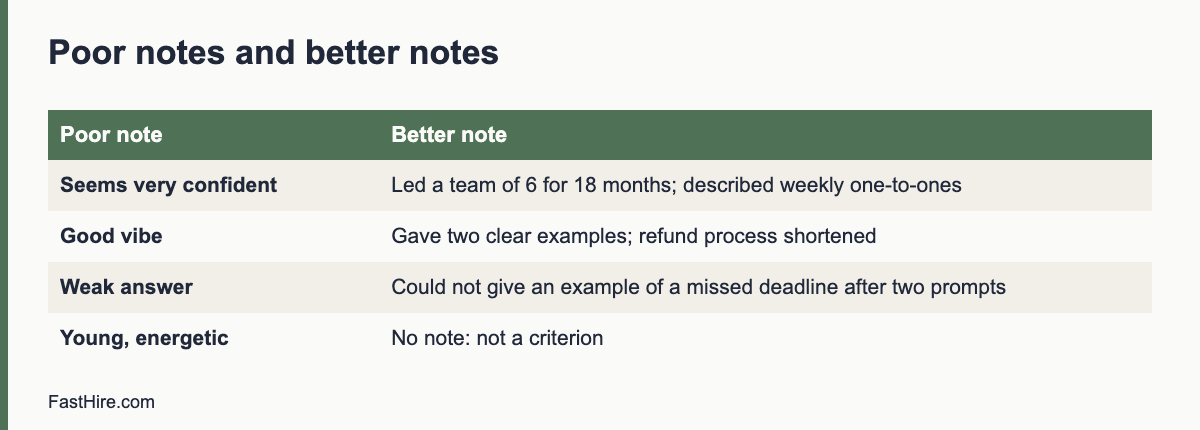
    Poor noteWhy it is poorBetter note
    “Seems very confident”Opinion; style not evidence“Led a team of 6 for 18 months; described weekly one-to-ones and a hiring plan”
    “Good vibe”Feeling; similarity bias“Gave two clear examples of resolving customer complaints; result: refund process shortened”
    “Probably will leave soon”Guess; may relate to age or familyNo note. If a retention concern is job-related, ask a question about career plans for this role
    “Young, energetic”Age signalNo note
    “Weak answer”No evidence“Could not give an example of handling a missed deadline; said ‘it did not happen’ after two prompts”
    “Struggled with English”Vague; may relate to origin“Answer to question 3 took three attempts to clarify; written test shows clear writing” (only if language level is a stated criterion)

    Good notes quote key phrases, state numbers and name the actions the candidate took. They link to the criterion being tested. They are short enough to write while listening.

    A note sheet you can copy

    QuestionCriterionEvidence (facts and quotes)Score (1 to 4)
    1. Tell me about a time you handled a difficult customer.Customer skills
    2. Describe how you plan a week with many deadlines.Planning
    3. Tell me about a mistake you made at work.Learning
    4. Walk me through your use of [tool].Tools
    5. Availability and noticePractical fit

    Add a header with the candidate’s name or code, the role, the date, the interviewer and the start and end time. Add a box at the bottom for the three strongest points, the biggest doubt and the overall recommendation. Fill in the last box after you score.

    Techniques that work

    Write in short forms

    Use abbreviations you will understand later, such as “Q2: led proj, 6 ppl, 18 mo, shipped on time”. Replace them with full words if you share the notes. Do not try to write everything. Write the facts that matter for the criteria.

    Mark each note against a criterion

    Draw a line or use a code (C1, C2, C3) for each criterion. After the interview, you can scan the sheet and see what evidence you have for each must-have.

    Use silence

    While you write, tell the candidate: “I am noting what you said, please continue.” Pauses are normal. A short silence often leads to more detail.

    Capture exact words for key points

    Write exact phrases when the wording matters, for example a number, a promise, or a clear statement about what the candidate did themselves. Use quotation marks to show these are exact words.

    Separate observation from interpretation

    Write observations in one column and interpretation in another, or do the interpretation later in your score. For example: observation, “said ‘the team did most of it’ when asked about the result”; interpretation, “unclear personal contribution; ask follow-up”.

    When two people interview together

    Split the roles. One person asks the questions and listens; the other takes notes. Switch roles for the second half. Compare notes after scoring alone, not before. Do not share impressions in front of the candidate. See how to run an interview panel well.

    What not to write

    • Protected traits: age, sex, race, religion, disability, sexual orientation, pregnancy, family status and similar. Remove them if the candidate volunteered them.
    • Comments about appearance, accent, voice or clothing, unless a stated and lawful job requirement relates to them.
    • Guesses about the reason for a gap, a move or a choice.
    • Comparisons with other candidates. Compare in the debrief using scores.
    • Insults, jokes or private opinions. Notes can be read later by others.

    If you wrote something you should not have, cross it out or delete it before filing and tell the HR contact if it relates to a legal risk. Do not alter records after a complaint has been made. Take advice. See what you can and cannot ask.

    Recording and tools

    MethodProsCons and rules
    Paper sheetSimple, no data risk if stored safelyHard to share; handwriting; must be stored and destroyed
    Digital document or formSearchable, sharedNeeds access control and retention rules
    Applicant tracking systemCentral; links to the candidate recordCheck retention and access settings
    Audio or video recordingComplete recordNeeds a lawful basis and the candidate’s knowledge; many countries require explicit notice or consent; heavy to store
    Automatic transcription toolsFastCheck data protection, accuracy, bias and where data is processed; people must still make the decision

    If you record or transcribe, tell candidates in advance, explain why, how long you keep it and who sees it. In the UK and EU, data protection law applies. See the ICO employment guidance and the GDPR text. In the US, recording laws differ by state, with some requiring all parties to consent. Take local advice. This is general information, not legal advice.
    Storing, sharing and deleting notes

    1. Store notes in one secure place with access only for the hiring team.
    2. Do not email notes to personal accounts or share in public chat.
    3. Label them with a code or name, role and date.
    4. Set a deletion date based on the law and your retention policy. For unsuccessful candidates this is often a limited period. Check the rules for your country.
    5. Delete or anonymise after the date and record that you did.
    6. If a candidate asks to see their data, follow the legal process. In the UK and EU, this may be a subject access request.

    Write every note as if the candidate might read it, because in some places they may be able to. This is a good test of tone and fairness.

    A worked example (fictional)

    This example is invented. An interviewer uses a sheet with five questions. For question 1, she writes: “Handled 30-40 tickets a day; used a help desk tool; refund replies; one angry customer: apologised, issued refund in 1 day, customer thanked team in follow-up”. She scores 3. For question 3, the candidate says, “I do not make mistakes.” After a prompt, the candidate gives a minor example. She writes: “First answer: none. After prompt: sent wrong template once; checked tone after; now reads twice before sending”. She scores 2 and notes the need for a follow-up on learning from errors. She does not write about the candidate’s accent or the fact that he mentioned his children in small talk. After the interview she writes three strongest points and one doubt, files the sheet and joins the debrief with her notes ready. The debrief takes 20 minutes because the evidence is clear.

    From notes to score: a five-minute routine

    1. Read your notes for question 1. Underline the facts that relate to the criterion.
    2. Compare them with the scale anchors. Choose the score that matches the evidence, not the best answer you heard that day.
    3. Write one line to justify the score.
    4. Repeat for each question. Do not go back to change a score unless you find a clear error.
    5. Write the three strongest points, the biggest doubt and the recommendation. Add the time.

    The routine takes five to ten minutes after a 45-minute interview. It turns a messy page into clean evidence. If you find that you cannot score a question, note “no evidence” and ask the candidate a follow-up in a later step, such as a reference call or a short written question.

    Sharing notes in the debrief

    In the debrief, share your scores and the evidence lines, not the full page. Others can ask to see the notes if they need to check. Do not read out personal remarks. If another interviewer’s note includes a protected trait or an opinion without evidence, ask them to remove it or restate it as a fact related to a criterion. A short, polite prompt keeps the record clean for everyone.

    Notes for candidates who are not hired

    Notes also support feedback. When you decline a late-stage candidate, use your notes to choose two job-related points: one strength and one gap in the evidence. This is faster and more accurate than writing from memory. Keep the language neutral and based on the criteria. See how to give fast interview feedback.

    Over time, review a sample of your own notes. Ask whether another person could understand the evidence, whether the notes relate to the criteria and whether any comment would look unfair if read aloud. Adjust your habits. Better notes improve every later step in the hiring process.

    Notes on a screen: tips for video interviews

    • Place the note sheet on a second screen or on paper, not over the video window, so that you can keep eye contact.
    • Tell the candidate if you look down to write, so they do not read it as a lack of interest.
    • Do not use the chat window for notes that could be shared by mistake.
    • Mute notifications and close other applications.
    • Check that your note file is not in a shared folder that others can open by mistake.

    Notes on a screen can also be copied or shared more easily than paper. Use a document that is saved in a private location with a clear name, and delete drafts. If you use a tool that records or transcribes, check settings before the interview. Treat every file as personal data that you are responsible for.

    A short checklist

    • The note sheet matches the question list.
    • Each note is linked to a criterion.
    • Facts, numbers and quotes are written down.
    • No protected traits or appearance comments.
    • Scores are written within 15 minutes.
    • The file is stored securely and a deletion date is set.

    When in doubt, return to the purpose of the notes: they exist so that a decision can be explained with facts. If a note does not help to explain a decision, leave it out. Concise, factual notes are easier to score and to review, and they save time in every later step of the process.

    Remember that clear notes are a gift to your future self. A month later, when the new hire asks why they were chosen, or a colleague asks for the evidence behind a decision, you can answer in a minute with facts, instead of reconstructing a conversation from memory.

    Frequently asked questions

    Should I take notes during an interview?

    Yes. Tell the candidate you will, and why. Notes protect fairness and help your decision.

    What should I write down?

    Facts, numbers, key phrases and actions the candidate took, linked to your criteria. Leave out feelings and protected traits.

    Can I record an interview?

    Only with a lawful basis and usually with the candidate’s knowledge or consent. Check local rules.

    How long should I keep interview notes?

    Only as long as needed and as the law allows. Set a deletion date in your retention policy.

    Can candidates see my notes?

    In some places they can request their personal data, including notes. Write notes you could stand behind.

    Related guides

    This is general information, not legal advice.
  • How to write job requirements candidates can actually check themselves against

    How to write job requirements candidates can actually check themselves against

    Most job adverts ask candidates to do something impossible: read a list of adjectives and decide whether they qualify. “Excellent communicator.” “Strong commercial awareness.” “Proactive self-starter.” Nobody reads those lines and thinks “no, that is not me”. So everyone applies, and the work of figuring out who actually fits lands back on your desk.

    A requirement is only useful if a candidate can check it against their own experience and give an honest yes, no or “partly”. This guide walks through how to write requirements that pass that test. It applies whether you hire in Manchester or in Utrecht, and whatever tools you use.

    Key takeaways

    • A requirement is checkable when a candidate, or a reviewer, can point to proof in a CV or an answer.
    • Describe the work or the outcome, not the personality. Name the level in terms of tasks, not years.
    • Split compound items so that each line has one test.
    • Keep the list short: three to five must-haves are easier to check than twelve.
    • Test every line for fairness before you publish it.
    x

    The test: could a candidate point to the evidence?

    Before a requirement goes into the advert, ask one question: if a candidate had this, where in their CV or their working life would it show up?

    If the answer is a specific thing (a qualification, a tool they have used, a type of work they have done, a responsibility they have held) the requirement is checkable. If the answer is “it would come across in how they write” or “you can just tell”, it is not a requirement. It may still matter, but it belongs in the interview, not the filter.

    Some quick rewrites:

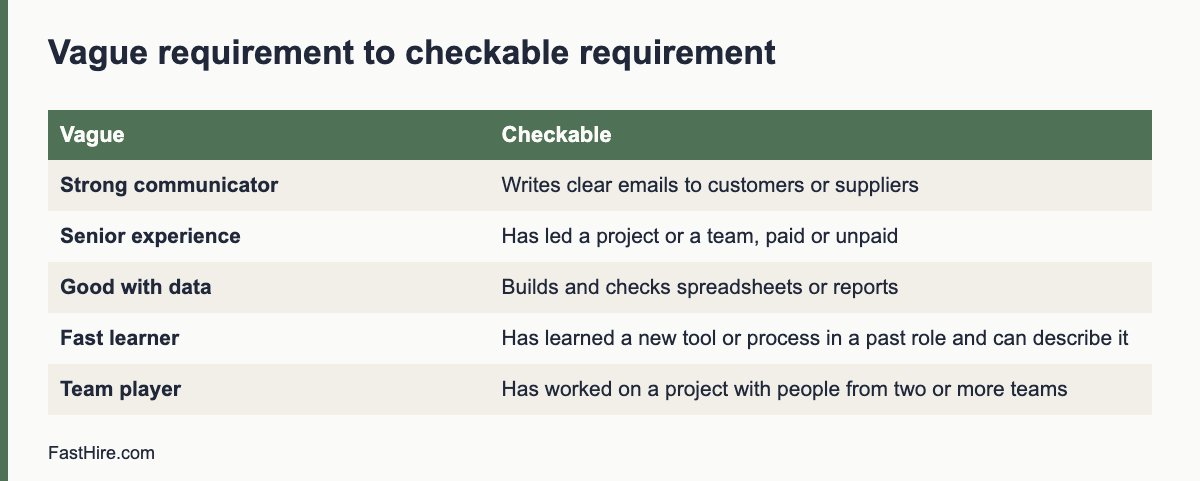
    • “Excellent communication skills” becomes “Has written customer-facing documents, such as reports, proposals or help articles”.
    • “Strong Excel skills” becomes “Has built spreadsheets with lookups and pivot tables for regular reporting”.
    • “Commercially minded” becomes “Has worked to a sales or budget target and can describe how they tracked it”.
    • “Fluent Dutch” becomes “Can hold a work meeting in Dutch (roughly B2 level or higher)”.

    Each rewrite is longer. A candidate reading it knows whether they have done that thing. You, reading their application, know what to look for.

    Describe the work, not the person

    Requirements written about personality (“dynamic”, “energetic”, “a good cultural fit”) are hard to check and easy to apply unfairly. They invite reviewers to fill the gap with gut feeling, which is where bias tends to creep in.

    Requirements written about the work are different. “Has handled a caseload of customer complaints from first contact to resolution” describes something a candidate either did or did not do. It also tells them what the job involves, which helps the people who would hate it to decide not to apply.

    A useful habit: write down the three to five things the person will spend most of their week doing. Then write each requirement as evidence that someone has done one of those things before, or something close to it.

    Be specific about level, not about years

    “Five years’ experience” is one of the most common requirements in job ads, and one of the least useful. Years are a proxy. What you usually want is a level of responsibility or a range of situations the person has handled. Someone can do the same thing for five years, and someone else can cover a lot of ground in two.

    Time-based requirements also carry a legal risk. In the UK, a requirement that is harder for one age group to meet can amount to indirect discrimination under section 19 of the Equality Act 2010 unless you can show it is a proportionate means of achieving a legitimate aim. The Netherlands has comparable protection against age discrimination in employment under the Wet gelijke behandeling op grond van leeftijd bij de arbeid. Neither law bans asking for experience. Both mean you should be able to explain why the specific thing you asked for is needed.

    So instead of “5+ years in accounts payable”, try “Has run a month-end close for accounts payable, including supplier reconciliations”. That says what you actually need, and a strong candidate with three years can recognise themselves in it.

    Name the tool, or say you do not care which one

    “Experience with CRM systems” leaves a candidate guessing. Do you use Salesforce and need someone who knows it? Or would any CRM do, because the skill is keeping customer records tidy?

    Pick one:

    • If a specific tool matters, name it: “Has used Salesforce to manage a sales pipeline”.
    • If it does not, say so: “Has used any CRM (for example HubSpot, Salesforce or Pipedrive) to manage customer records”.

    The second version widens your pool without lowering the bar. It also prevents candidates who used a different system from ruling themselves out.

    Split compound requirements

    “Experience in project management and stakeholder engagement in a regulated environment” is three requirements in a trench coat. A candidate who has two of the three cannot answer it honestly with a yes or a no.

    Break it up:

    1. Has planned and delivered a project with a fixed deadline.
    2. Has reported progress to senior people outside their own team.
    3. Has worked in a regulated sector such as finance, healthcare or energy.

    Now the candidate can check each one, and you can see which parts they have. You may also discover, once it is written out, that only one of the three is really essential.

    Separate the yes/no facts

    Some things are not about skill at all. They are facts about the candidate’s situation:

    • Do they have the right to work in the UK, or in the Netherlands?
    • Can they start by a certain date?
    • Can they work on site in Rotterdam three days a week?
    • Do they hold a driving licence, if the job involves driving?

    These belong in short yes/no questions that the candidate answers themselves, not mixed into the skills list. Keep them to what the job really needs, and do not ask for information you have no reason to collect. Under UK GDPR and the GDPR in the Netherlands, collecting only what you need is a legal principle, not just good manners. The UK regulator, the ICO, has guidance on recruitment and selection that is worth reading before you design an application form.

    Keep the list short

    A long list does not make an advert more rigorous; it puts off people who meet the core needs. Aim for three to five requirements that genuinely decide whether someone can do the job, then a short, clearly labelled list of things that would be a bonus. (There is a separate post on how to split must-haves from nice-to-haves.)

    A worked example

    Here is a requirements section for a customer support lead role, before and after.

    Before:

    • Excellent communicator with a passion for customers
    • 5+ years in customer service
    • Experience with ticketing systems
    • Strong leadership skills
    • Degree preferred

    After:

    • Has handled customer queries by email or chat, including complaints, and resolved them without escalation in most cases.
    • Has led or coached a small team (two or more people), including running regular one-to-ones.
    • Has used a ticketing system such as Zendesk, Freshdesk or similar to manage a shared queue.
    • Can write clear help articles or reply templates in English.

    Yes/no questions: right to work in the UK; able to work UK hours.

    The “after” version drops the degree (the work does not need it), drops the years (the coaching requirement captures the level), and turns every line into something a candidate can find, or not find, in their own history.

    Why this pays off

    When candidates can check themselves against your requirements, more of the people who apply are people who meet them. When you review, you are comparing evidence against clear statements instead of reading between the lines.

    It takes an extra half hour to write requirements this way. That half hour comes back many times over at the review stage, and it gives every applicant a fairer, clearer picture of what you are asking for.

    Twelve rewrites you can copy

    Vague requirementWhy it is hard to checkCheckable version
    Excellent communication skillsEveryone claims it; no task namedWrites clear emails or reports for customers, suppliers or colleagues
    Senior-level experienceTitles differ across companiesHas led a project, a team or a process change, paid or unpaid
    Strong analytical skillsNo task namedUses data to answer a business question, for example building a monthly report
    Proficient in Excel“Proficient” means different thingsBuilds spreadsheets with formulas and checks totals for accuracy
    Self-starterA trait, not a taskHas started or improved a process without being asked, and can describe it
    Busy environment experienceUnclear what paceHas handled several customer requests or deadlines in the same day
    Team playerA trait, not a taskHas worked on a project with people from two or more teams
    Customer-focusedVagueHas resolved customer complaints or questions in writing or by phone
    Detail-orientedCannot be checked on a CVHas checked records or documents for errors as a regular task
    5+ years of experienceYears do not show skillHas done [named task] on [number] projects or for [named volume]
    Degree requiredMay exclude people with the skillDegree only if the law or a regulator requires it; otherwise, name the knowledge
    Native English speakerSignals national originWrites and speaks English at the level needed for [task], for example handling customer calls

    Three questions to check each line

    1. Could a candidate point to proof? For example, a job task, a project, a result or a sample of work. If the proof would be “I am a good communicator”, the line is not checkable.
    2. Could two reviewers agree? Give two colleagues the same CV and the requirement. If they mark it differently, the wording is too loose.
    3. Is it needed on day one? If the person could learn it in the first three months, move it to nice-to-have. See must-haves vs nice-to-haves.

    A fairness check on every line

    Wording can exclude people without anyone intending it. Before you publish, read each line with these questions in mind.

    CheckExample of a problemBetter wording
    Age“Digital native”, “recent graduate”, “up to 10 years of experience”Name the tool or the task
    Sex or gender“Salesman”, “he will”“Sales representative”, “the person”
    Disability“Must be able to stand for eight hours” for an office roleDescribe the essential tasks and allow for adjustments
    National origin“Native speaker”, “must be from the area”State the language level needed for the tasks
    Family status“Must be able to work late any day”State the actual schedule needs and any flexibility
    Other“Cultural fit”Describe observable behaviours linked to the work

    The official sources on equal treatment give the baseline. In the US, see the Equal Employment Opportunity Commission page on prohibited employment policies and practices. In Great Britain, see Acas on recruitment. In the EU, see the Employment Equality Directive and your national law. Our guide to interview questions you cannot ask covers a related set of risks.

    A requirement card

    For each must-have, fill in one short card. Keep the cards in the role brief, and share them with the recruiter and the interview panel.

    FieldExample (fictional)
    RequirementWrites clear emails to customers
    Why it mattersThe role answers 30 to 50 customer emails each day, and unclear replies create repeat contacts
    What counts as proofA job task that includes customer email; a writing sample; a described example of resolving a complaint in writing
    What does not count aloneThe phrase “excellent communicator”
    How we will checkCV passage first; one question in the interview; a short writing task for finalists
    Fairness check doneYes, by [name], [date]

    Cards take five minutes each, and they make later steps faster. The recruiter knows what to look for in a CV. The interviewers know what to ask. The candidate can read the card and decide honestly whether to apply.

    FastHire is being built around checkable requirements. It shows each job requirement next to the exact CV passage that supports it, so a reviewer can verify the evidence in seconds, and candidates can check their fit before they apply. FastHire is coming soon. It does not rank, score or reject candidates. People make every decision.

    Frequently asked questions

    What is a checkable job requirement?

    It is a requirement written so that a reviewer or a candidate can find proof of it in a CV or in an answer, such as “writes clear emails to customers”, instead of “excellent communicator”.

    How long should a requirement list be?

    Three to five must-haves is a good range. More than that reduces the pool and makes checking slow.

    Should I list years of experience?

    Only when the years connect to a task or volume you can describe. Years alone do not show skill and can exclude people who learned quickly.

    Can candidates check their fit before applying?

    Yes, if the advert is specific. Put the must-haves in plain words and say how you will check them.

    How do I test a new requirement?

    Give two colleagues the requirement and a few real CVs. If they disagree on the marks, rewrite the wording.

    Related guides

    This is general information, not legal advice.

  • How to write a job description for a role that does not exist yet

    How to write a job description for a role that does not exist yet

    To write a job description for a role that does not exist yet, start with the problems the role must solve, not with a list of skills. Write three to five outcomes, turn each into tasks, then list the few skills and experience a person needs to do those tasks. Treat the first version as a draft and plan to revise it after the first interviews.

    Key takeaways

    • Start from outcomes and tasks, not from a wish list of qualities.
    • Limit must-haves to three to five items that you can check on a resume or CV.
    • Write what is not known yet, and say the role may change. Candidates respect honesty.
    • Test the draft with two people who do similar work, and with one person who does not.
    • Plan a review after the first five interviews. Change the document, not the standard for each candidate.
    x

    Why a new role is harder to write

    When a role exists, you can copy and update an old description. A new role has no history. Founders often fill the gap with a long list: “self-starter, strategic, hands-on, five years of experience, great communicator”. That list describes a person who may not exist, and it hides the real work. It also attracts few applicants, and it can exclude strong people who do not match each phrase.

    A better approach is to describe the work first. If you can describe the work in plain words, you can find people who have done something like it.

    The seven-part method

    PartQuestion to answerLength
    1. ProblemWhat is not working today, or what do we want to start?2 to 3 sentences
    2. OutcomesWhat will be true after 6 and 12 months if this hire succeeds?3 to 5 bullets
    3. TasksWhat will the person do in a normal week?6 to 10 bullets
    4. Must-havesWhich few skills or experiences are needed from day one?3 to 5 bullets
    5. Nice-to-havesWhat helps but can be learned?2 to 4 bullets
    6. ContextTeam, reporting line, hours, place, pay rangeShort list
    7. UnknownsWhat is not decided yet?2 to 3 sentences

    Part 1: State the problem

    Write the problem as if you were telling a friend. For example: “Our customers wait two days for an answer, and the founders answer most emails at night.” This helps candidates see why the role exists and helps you check whether you need a hire at all.

    Part 2: Write outcomes

    An outcome is a result, not an activity. “Answer customer emails within one working day” is an outcome. “Check the inbox” is an activity. Write outcomes for the first 6 months and the first 12 months. If you cannot write outcomes, you may not be ready to hire. Our guide to the one-page role brief goes deeper on this step.

    Part 3: List tasks

    List what the person will do in a normal week. Use verbs: answer, write, update, report, schedule, check, call. Avoid vague words such as “support” and “manage” without an object. Say how much time each task takes if you know.

    Part 4: Choose a few must-haves

    Take each outcome and ask: what skill or experience would make this task possible on day one? Write only those. Keep the list to three to five items. Each must be something a person can show on a CV or in an interview. See must-haves vs nice-to-haves and how to write requirements candidates can check themselves.

    Part 5: Name the nice-to-haves

    Nice-to-haves are skills that help, but you can teach them in the first months. Keep them short. Say clearly that they are optional so that candidates do not rule themselves out.

    Part 6: Add the context

    Include the reporting line, the team size, the hours, the place of work, the pay range and the type of contract. In some places the law requires pay information. Check the rules where you hire.

    Part 7: Be honest about the unknowns

    Say what is still open. For example: “This is a new role. We will review the tasks after three months and agree changes with you.” This honest statement attracts people who like building and filters out people who need a fixed structure.

    A template you can copy

    SectionFill in
    Job titleUse a common title that people search for
    Why this role existsTwo or three sentences on the problem
    What you will achieveOutcomes at 6 and 12 months
    What you will do6 to 10 tasks with verbs
    What you need3 to 5 must-haves, each checkable
    What helps2 to 4 nice-to-haves
    About the teamSize, manager, how you work
    Hours, place and payHours per week, location, range, contract type
    What is not decidedThe open points
    How to applyCV or resume, and one short question if needed
    Our processSteps and expected timeline

    A fictional example

    This example is invented. A small online shop has never had an operations role. The founder writes the following draft.

    PartDraft text
    TitleOperations coordinator
    Why this role existsWe ship about the same orders each week, but delays and errors take the founder’s evenings. We want one person to own the process from order to delivery.
    OutcomesWithin 6 months: orders leave within one working day. Within 12 months: the number of wrong or late orders falls and the founder no longer handles daily shipping.
    TasksCheck new orders. Pack or direct packing. Book couriers. Answer delivery questions. Track errors in a sheet. Order packaging. Suggest process changes.
    Must-havesExperience in an order, warehouse or logistics task. Clear written communication. Comfort with spreadsheets. Able to work the stated hours.
    Nice-to-havesExperience with an online shop platform. Basic knowledge of courier systems.
    UnknownsWe may add customer service tasks after three months. We will agree this with you.

    Notice that the draft says nothing about “passion” or “ninja”. It names tasks and checkable skills. Someone with warehouse or retail stock experience could apply, which widens the pool in a fair way.

    Test the draft

    1. Ask two experts. Find two people who do similar work, even in another business. Ask: “Is this realistic for one person? What is missing?”
    2. Ask one outsider. A friend outside the field should be able to explain the job back to you in two sentences. If not, simplify.
    3. Check for proxies. Remove anything that is not needed for the work, for example years of experience that function as an age signal, or a degree where a skill would do.
    4. Check the load. If the tasks need more than the hours you offer, cut tasks or raise hours.
    5. Check the pay. Compare the pay with the tasks and the market. See the cost worksheet.

    Review after five interviews

    A new role changes as you talk to people. After the first five interviews, hold a 20-minute review. Ask: Which tasks did candidates find unclear? Which must-have did nobody meet? Which one did everybody meet, so that it no longer helps you choose? Change the document, record the date, and apply the new version to all candidates, including those you have already seen. Do not lower the standard for one person you like.

    Common mistakes

    MistakeWhy it hurtsFix
    Copying a large company’s descriptionIt describes a team and tools you do not haveWrite from your own tasks
    Listing 15 must-havesStrong people rule themselves outKeep to 3 to 5
    Using “rockstar”, “ninja” or “culture fit”Vague and can exclude peopleDescribe behaviour and tasks
    Hiding the payCandidates cannot judge the fit; may be illegal in some placesGive a range where possible
    Making the role a copy of the founderNo one matches thatDescribe the work, not the person

    For more on wording the ad that you publish from this description, read how to write a job ad that attracts the right applicants. If this is your first employee, also read the first hire plan.

    Turn tasks into interview questions

    A good description doubles as an interview plan. For each must-have, write one question that asks for a real example. Ask every candidate the same questions in the same order. This is fair, and it makes answers easy to compare.

    Must-haveQuestion to askWhat a strong answer includes
    Order or logistics experienceDescribe a time you handled a busy week of orders. What went wrong and what did you change?A specific situation, the action the person took and a result
    Clear written communicationTell me about a message you wrote to explain a problem to a customer or colleague.A clear purpose, a reader in mind, a result
    Spreadsheet comfortWhat do you track in a spreadsheet and how do you check it for errors?A named task, a method and a check
    Works the stated hoursThese are the hours. Is there anything we should talk about?A direct answer. Do not ask about family or health

    Score each answer against a short scale and write the evidence. A scorecard is simple to build; see our interview scorecard template.

    What to do if the role changes after you hire

    New roles drift. After three months, hold a short meeting with the new employee. Compare the original outcomes with what really happened. Ask what takes the most time and what is missing. Update the description and agree the changes in writing. If the change is large, such as a different level of work or different hours, treat it as a contract change and take advice. Do not quietly add tasks that were not in the agreement. That causes stress and can create legal problems in some countries.

    A short, honest description at the start makes this review easy. You can show the person the original document and ask: “What is still true, and what has changed?” This is a respectful way to shape a new role with the person who holds it.

    A 15-minute checklist before you publish

    • The job title is one that people search for.
    • The first two sentences say why the role exists.
    • There are three to five outcomes.
    • Tasks start with verbs.
    • There are no more than five must-haves, and each can be checked.
    • Nothing in the text points to age, sex, race, religion, disability or family status without a job reason.
    • The pay range, hours and place are stated.
    • The unknowns are named.
    • The application step is simple and takes under 10 minutes.

    Where the description is used

    Write the full description once, then reuse it in four places. The ad uses the problem, the outcomes, the must-haves and the pay. The interview plan uses the must-haves and tasks. The offer letter uses the title, hours and place. The first-month plan uses the outcomes. When one document drives all four, candidates hear the same story at every step, and you spend less time writing. Keep one copy with a date, and update it whenever the role changes, so that nobody works from an old version.

    Official sources for this topic: EEOC: small business guidance, GOV.UK: employing people. These pages are maintained by the authorities and may change, so check them for the current text.

    Frequently asked questions

    How long should a job description be?

    One page is enough for most roles. Use short sentences and lists. Candidates read the ad, so the ad can be shorter than the internal document.

    Should I include the salary?

    Yes if you can. Pay information helps candidates decide and, in some places, the law requires it. Check the rules where you hire.

    What if I do not know the exact tasks?

    Write the outcomes and the first three months of tasks. State that the role will change and how you will agree changes.

    Can I use a template from the internet?

    You can use it as a prompt, but write your own tasks and must-haves. A generic template may contain requirements that you do not need.

    How many must-haves are too many?

    More than five is usually too many. If you have more, move the lowest ones to nice-to-haves or cut them.

    Related guides

    This is general information, not legal advice.
  • How long should hiring take? A realistic timeline for small teams

    How long should hiring take? A realistic timeline for small teams

    Hiring takes as long as the slowest step you do not plan. For a small team, a realistic plan has six stages: prepare the role, advertise, screen, interview, decide and offer, and wait for the start date. This guide shows a week-by-week template, where time is usually lost, and how to shorten each stage without cutting fairness. The times here are planning assumptions, not statistics.

    Key takeaways

    • Plan the whole journey, from role brief to start date, before you open the job.
    • The longest delays are usually waiting for decisions, scheduling and notice periods, not reading CVs.
    • Use a planning template to the start date, then replace it with your own measured times after your first hire.
    • Set a closing date, a screening day, interview slots and a decision date in advance.
    • Keep candidates informed at each stage. Silence loses good people.
    x

    Two clocks: time to hire and time to start

    People use “how long does hiring take” to mean two different things. Time to hire is the time from opening the role to the candidate accepting the offer. Time to start adds the notice period that the candidate must serve at their current job. In some countries notice periods are short, and in others they are several months. The notice period is not under your control, so ask about it early. Our first hire plan shows where each step fits.

    Be careful with published averages. Different sources count different things, and the numbers vary by industry, role and country. If you quote a statistic, link it to a source. In this guide we offer planning assumptions that you can adjust, not market statistics.

    A week-by-week template

    StagePlanning rangeMain tasksWho decides
    1. Prepare3 to 7 daysWrite the role brief, job ad and scorecard; agree pay and processYou
    2. Advertise14 to 21 daysPost the ad, answer questions, send acknowledgementsYou
    3. Screen2 to 4 daysUse a sheet to mark yes, no, unclear against the must-haves; choose who to interviewYou and a second reviewer
    4. Interview5 to 10 daysPhone screens and one or two interviews; score each one right afterYou and one more person
    5. Decide and offer3 to 5 daysCheck references, decide, call, send the offer; give time to replyYou
    6. Notice and startVariesWait for notice period; keep in touch; prepare onboardingCandidate and you

    This adds up to roughly 5 to 8 weeks to the offer, plus the notice period. If your applicants are mostly unemployed or available at once, the start date can be much sooner. If they are senior and need to give three months’ notice, it will be later. These ranges are a starting point for your own plan.

    Where time is usually lost

    DelayWhat happensFix
    Unclear roleWeeks of rewriting the ad and criteriaWrite a role brief first
    Open-ended adNo closing date, so screening never startsSet a closing date two to three weeks ahead
    Slow screeningCVs wait in an inboxBook a screening session on the calendar. Use a 20-minute method
    SchedulingMany emails to find an interview timeOffer fixed slots on set days
    Waiting for a second opinionDecision sits for a weekName the decision maker and the date
    Reference checks lateAnother week lostAsk for referees at the final interview
    Offer too slowThe best candidate accepts another jobKeep the offer within 2 days of the decision
    Notice period surpriseStart date moves by monthsAsk about notice at the first call

    How to shorten each stage without lowering quality

    Prepare

    Prepare one hour in advance for each later step: the ad, the question list and the scorecard. Many delays start because someone writes the question list on the morning of the interview.

    Advertise

    Use channels that reach the right people. If you get enough suitable applicants in the first week, close early and say so in the ad (“we may close earlier if we receive many applications”). Do not leave the ad open for months. See where to post a job when you have no budget.

    Screen

    Screen in one block. Mark the same criteria for every person. If you have a second reviewer, split the pile in two and compare a sample of 10.

    Interview

    Book all first interviews in two or three days. Use 30 to 40 minute slots with 15 minutes between for notes. Use the same questions. See how to run a first interview.

    Decide and offer

    Hold a decision meeting right after the last interview, or on the next morning. Review the scorecards and decide. Then call the candidate and send the written offer on the same day. See how to make a job offer.

    What not to speed up

    • Do not skip a written list of criteria. It slows you down later when you must justify your choice.
    • Do not skip right-to-work checks or other legal checks.
    • Do not pressure candidates with unreasonable deadlines.
    • Do not choose the first person who looks good. Compare at least three people against the same criteria, if you have them.
    • Do not cut feedback to candidates. A short message takes a minute.

    Speed and fairness work together when the process is clear. A written plan speeds up every step, and it also shows that you treated everyone the same.

    A calendar example (fictional)

    WeekAction
    Week 1Write role brief and ad; set pay; set interview days in the calendar
    Weeks 2 and 3Ad open; answer questions; acknowledge applications
    Week 4, MondayClosing date. Tuesday: screening session. Wednesday: invitations sent
    Week 4, Thursday and FridayPhone screens
    Week 5, Monday to WednesdayInterviews
    Week 5, ThursdayDecision meeting; call preferred candidate; ask for referees
    Week 6, MondayReferences checked
    Week 6, TuesdayOffer sent; reply date Friday
    Week 7Candidate accepts; give notice; keep in touch
    Week 11Start date, if notice is four weeks

    The dates are invented. Replace them with your own and put each one in your calendar before you post the job.

    Tell candidates the timeline

    Put the timeline in the ad and in the first message. For example: “Applications close on [date]. We will invite people to interviews on [date] and decide by [date].” People plan around dates. If your dates slip, tell them. A short message that says “we need two more days” is better than silence.

    Measure your own time

    NumberHow to measureUse
    Days from opening to closingDate posted to date closedCheck ad length
    Days from closing to interviewClosing date to first interviewCheck screening speed
    Days from last interview to offerDate of last interview to date of offerCheck decision speed
    Days from offer to acceptanceOffer date to replyCheck offer clarity
    Days from acceptance to startReply date to startPlan notice periods

    Record these in a spreadsheet for every hire. After two or three hires you will know your real timeline and where you lose time. Our upcoming spreadsheet tracker guide shows a simple layout. For the cost of waiting, see what a bad hire really costs and the cost worksheet.

    Message templates that keep the timeline on track

    Acknowledgement after an application

    Hello [Name],

    Thank you for applying for the [job title] role. We received your application. Applications close on [date]. We will contact everyone by [date] with a clear answer about the next step.

    Best wishes,
    [Name]

    Interview invitation with slots

    Hello [Name],

    Thank you for your application. We would like to invite you to a 40-minute interview for the [job title] role. These slots are open on [dates and times]. Please reply with the one that suits you. The interview will be [in person at address / by video]. If you need any adjustment, please tell us and we will arrange it.

    Best wishes,
    [Name]

    Delay notice

    Hello [Name],

    We need [number] more days to finish our interviews. We will contact you by [new date] with a decision. Thank you for your patience.

    Best wishes,
    [Name]

    If you must hire faster than the template

    Sometimes a person leaves with little warning, or a contract starts soon. In that case, change the plan in these ways, and keep the fair steps.

    OptionHow it saves timeRisk to manage
    Shorter ad periodClose after 7 to 10 daysFewer applicants; check the pool is still varied
    Combine phone screen and first interviewOne conversation instead of twoLonger call; use the same questions for all
    Interview in one blockAll interviews on two daysPlan your notes and scoring time
    Use temporary coverA temp or freelancer covers the gapCheck the status rules in employee or contractor
    Ask finalists for references earlySaves days at the endAsk for permission first

    Do not drop your criteria, your scorecard or the legal checks. A hire made in a hurry that fails costs more than a short delay. Read what a bad hire really costs to compare.

    A 30-minute decision meeting

    Many hires stall at the decision. A fixed agenda keeps the meeting short and fair.

    MinutesItemRule
    0 to 5Reminder of the must-haves and the scorecard scaleEveryone uses the same criteria
    5 to 15Each interviewer reads their scores and the evidence behind themScores come first, opinions second
    15 to 22Discuss differences of two points or moreReturn to the notes, not to memory
    22 to 27Name the top choice and a back-upWrite the reasons
    27 to 30Agree who calls, when and what to offerSet the date

    If the group cannot agree, do not extend the process by default. Ask which must-have is the real point of difference and whether you can test it with a short task or a reference call. Then decide by the agreed date.

    When a candidate has other offers

    Good candidates often have more than one process running. Ask in the first call: “Are you in other processes? What timeline are you working to?” Do not pressure or insult. If your timeline is longer than theirs, say what you can do, and let them decide. If you really want a person, you may move your steps closer together, but do not skip checks. Never invent a rival offer or a false deadline. Honest timing builds trust, and trust makes acceptance more likely.

    Keep a log for next time

    After the hire, spend 20 minutes with a sheet and write the real dates, the delays and one change to make. Keep it with the role brief. Next time you hire, start from this log and your timeline will be shorter. Over several hires it becomes your own benchmark, which is more useful than any general average.

    Official sources for this topic: US Small Business Administration: hire and manage employees, GOV.UK: employing people. These pages are maintained by the authorities and may change, so check them for the current text.

    Frequently asked questions

    How long does it take to hire someone?

    It depends on the role, the market and your process. Plan 5 to 8 weeks to an accepted offer for a typical small business role, plus the candidate’s notice period. Measure your own times.

    Can I hire in one week?

    Sometimes, for simple roles with available candidates, if you prepare in advance. Do not skip fair steps or legal checks to go faster.

    What is the biggest cause of delay?

    Waiting for decisions and scheduling. Fix dates in advance and name one decision maker.

    Should I tell candidates the timeline?

    Yes. A clear timeline reduces drop-out and questions.

    What if the best candidate has a long notice period?

    Ask if they can start part-time earlier, if their contract and your rules allow it. Otherwise plan temporary cover. Do not ask them to break their contract.

    Related guides

    This is general information, not legal advice.
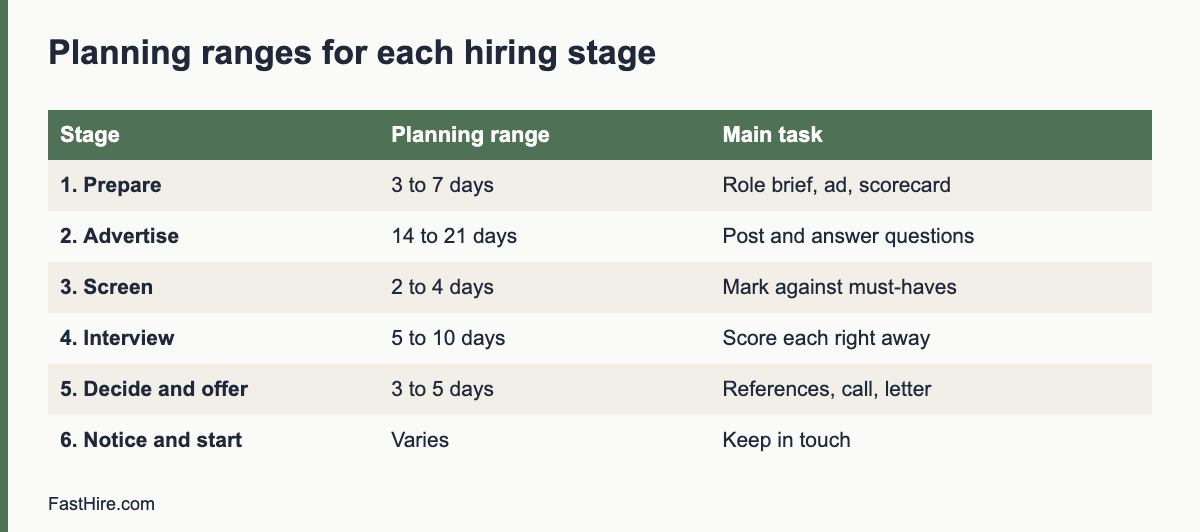
  • How to write a good interview plan for a new role

    How to write a good interview plan for a new role

    A good interview plan maps each must-have for the role to one interview stage and one question or task, names who will assess it, and sets the scoring scale before you meet any candidate. For a new role, start with the outcomes the person must deliver, choose two to four stages, and make sure no must-have is tested twice or missed.

    Key takeaways

    • Start from the must-haves, not from a standard list of questions.
    • Use a coverage matrix: each must-have appears in at least one stage and has a named assessor.
    • Two to four stages are enough for most roles. Each stage must test something new.
    • Brief interviewers, share the scorecard and agree the scale before the first interview.
    • Plan the candidate experience: timing, format, adjustments and a clear next step at each stage.
    x

    Why plan for a new role

    A new role has no history of what works. Interviewers often fall back on their favourite questions or on talk about personality. The result is an uneven process in which each candidate is judged on different things. A plan fixes this by linking every question to a requirement of the job. It also saves time, because you do not repeat topics or add stages that give no new information. If you have not yet written the role, begin with the one-page role brief and the guide to job descriptions for new roles.

    The five-step planning method

    StepTaskOutput
    1List the must-haves and outcomesThree to six items, each checkable
    2Choose assessment methodsOne method per must-have
    3Group into stagesTwo to four stages with time limits
    4Assign assessors and write questionsNames, questions and scoring guides
    5Plan logistics and communicationsSchedule, invitations, adjustments, feedback dates

    Step 1: List the must-haves

    Use the role brief. Write each must-have as a short statement that can be checked from evidence, for example “writes clear customer emails” or “plans work across several deadlines”. Avoid traits such as “driven” or “polished” unless you can define the behaviour.

    Step 2: Choose a method for each must-have

    MethodGood forLimits
    CV or resume reviewBasic experience, qualifications, toolsSelf-reported; can hide skill that is not written
    Phone or video screenMotivation, availability, basic fit with must-havesShort; use a script
    Structured behavioural interviewPast examples of skills and behaviourDepends on question quality and scoring. See behavioural questions
    Situational questionHow the person would handle a realistic problemAnswers can be idealised
    Work sample or taskDirect evidence of a skillTakes candidate time; keep it short and fair. Pay if it is long
    Portfolio reviewCreative and technical workCheck who did the work
    Reference checkConfirm facts and working styleLimited detail; see references

    Choose the method that gives the best evidence for the least burden on the candidate. Using more than one method for the same must-have rarely adds value. A mix of methods across different must-haves is better.

    Step 3: Group the methods into stages

    Typical stages for a mid-level role are: (1) a short screen of 20 minutes, (2) a structured interview of 45 to 60 minutes, and (3) a work sample or a second interview with a future colleague. Senior roles may add a short presentation. Entry-level roles may need only two stages. Each stage should answer a new question. If you cannot say what a stage will tell you that you do not already know, remove it.

    Step 4: Assign assessors and write questions

    Pick interviewers who know the work. Give each person a clear area. Write the questions in advance and share them with the interviewers. Do not let each interviewer ask the same general questions. Write a scoring guide: what a 1, 2, 3 and 4 looks like for each question. Our interview scorecard template shows an example.

    Step 5: Plan logistics and communication

    Decide the dates, the format, the length, the room or link and who sends invitations. Offer adjustments. Plan feedback dates. See how to give fast interview feedback.

    The coverage matrix

    Copy this table into a spreadsheet and fill it in. Each row is a must-have. Each column is a stage. Put an X where the must-have is tested, and write the assessor.

    Must-haveStage 1: 20-min screenStage 2: Structured interviewStage 3: Work sampleAssessor
    Plans work across deadlinesXHiring manager
    Communicates clearly in writingX (email sample)X (short written task)Recruiter, then manager
    Uses the main toolsX (quick check)XTeam lead
    Works with othersXFuture colleague
    Available for the hoursXRecruiter

    If a row has no X, you will not learn about that must-have. If a row has three X marks, you may be over-testing it. Aim for one or two per must-have.

    A worked example (fictional)

    This example is invented. A mid-sized company creates a new role: a customer onboarding specialist. The hiring manager writes four must-haves. She builds this plan.

    StageFormatTimeTestsAssessor
    1. ScreenPhone call with a script20 minutesAvailability, basic experience, written communication through a short email exercise sent in advanceRecruiter
    2. InterviewStructured behavioural interview, 6 questions50 minutesPlanning, working with customers, learning new toolsHiring manager and a senior colleague
    3. TaskDraft a welcome email and a one-page onboarding plan for a made-up customer45 minutes, paid time or optional take-home with a clear limitWritten clarity and planningTeam lead
    4. DecisionDebrief30 minutesAll scores reviewedFacilitator, then manager

    The plan has four steps but only three candidate-facing stages, and it takes about two hours of the candidate’s time. Each stage tests something new. The task uses a made-up case, not the company’s real data. The plan was shared with the candidate in the invitation, so there were no surprises.

    Time limits and candidate effort

    • Plan the total candidate time in hours. For most roles, three hours is a reasonable ceiling. For senior roles, it may be higher.
    • Do not ask for unpaid work that looks like real work for your business. Use a made-up case. If the task is long, pay for it.
    • Tell candidates the number of stages and the likely timeline in the job ad.
    • Offer a choice of times, and an alternative format if needed.
    • Remember that people who are working need slots outside office hours or by video.

    Brief the interviewers

    Hold a 20-minute briefing before the first interview. Cover:

    1. The role, the must-haves and the outcomes.
    2. The stage structure and each person’s area.
    3. The questions, in order, and the scoring guides.
    4. What not to ask. See our guide on what you can and cannot ask.
    5. How and when to submit scores and notes.
    6. How to describe the company and the role honestly.

    Give new interviewers a chance to practise with a colleague. Even five minutes of practice improves note-taking and reduces nervous talking.

    Plan for fairness and access

    IssueWhat to plan
    AdjustmentsOffer in every invitation: more time, written questions in advance, a quiet room, step-free access, a different format. Respond quickly
    Same questionsUse the same questions and time for every candidate, apart from adjustments
    Diverse panelInclude people with different backgrounds where you can
    Clear criteriaShare what you assess, in general terms, so candidates can prepare
    Fair tasksTest skills the job needs. Avoid tasks that favour people with free time or special tools
    RecordsPlan how you will store notes and for how long

    For the legal duties around adjustments, see Acas for the UK, the EEOC for the US and your national equality body in the EU. This is general information, not legal advice.
    Checklist before you open the role

    • Role brief and must-haves are final.
    • Coverage matrix is complete.
    • Questions and scoring guides are written.
    • Interviewers are named, briefed and have calendar time.
    • The task, if any, has been tested by a current employee.
    • Invitation templates are ready, with an adjustment offer.
    • Debrief date is booked.
    • Feedback standard is agreed.

    Question writing: from must-have to question

    Must-haveDraft questionFollow-upsScoring guide (1 to 4)
    Plans work across deadlinesTell me about a time you had several deadlines at once. How did you decide the order?What did you drop or delay? What happened?1: no example. 2: general example, no method. 3: clear method, outcome stated. 4: clear method, strong outcome, learning applied later
    Works with customersDescribe a customer problem you solved. What did you do yourself?How did the customer respond?1: no example. 2: example, little personal action. 3: clear personal action and result. 4: strong result and improvement to the process
    Learns new toolsTell me about the last tool you had to learn quickly. How did you do it?How long did it take to be productive?1: no example. 2: example, unclear method. 3: clear method, productive within a stated time. 4: also taught others or documented it

    Write the scoring guide before the first interview, and keep it fixed. If you change it, apply the change to every candidate. See behavioural interview questions for more examples.

    Choosing the order of stages

    Put the cheapest, most informative stage first. A short screen costs the candidate and you little time and removes clear mismatches on must-haves. Put the heaviest stage, such as a task or a panel, last, so that only finalists spend that effort. Use this order of effort: CV review, short call, structured interview, task or panel, references. If a must-have is a hard requirement such as a licence or the right to work in the country, check it early, in a way that you apply to all candidates.

    Keeping the plan alive

    After the first three interviews, check the plan against what you see. Ask: Did the questions produce usable evidence? Did interviewers use the scale in the same way? Did candidates understand the task? If a question produces the same answer from everyone, replace it. If interviewers differ widely on one must-have, clarify the scoring guide. Record any change and apply it to all candidates. At the end of the search, save the plan, the matrix and your notes. Next time you hire a similar role, you can start from the improved version and finish the plan in under an hour.

    Tools you can use

    You do not need special software to run a good plan. A shared spreadsheet holds the coverage matrix and the scores. A shared document holds the questions and the scoring guides. A calendar holds the schedule. If you use an applicant tracking system, check that it lets you attach scorecards and record dates. Whatever you use, keep the plan in one place that every interviewer can open, and keep it up to date, so that everyone works from the same version. When a person asks “what do we ask in stage two?”, the answer should be one click away.

    Review the plan with one person who has not seen it before. Ask them to find a must-have with no question, or a question with no must-have. Fix both before you open the role.

    Official sources for this topic: EEOC: employment tests and selection procedures, Acas: recruitment. These pages are maintained by the authorities and may change, so check them for the current text.

    Frequently asked questions

    How many stages should a hiring process have?

    Use the fewest that test your must-haves. Two to four is typical. Each stage should give new information.

    How many interviewers should I include?

    Two to four people. More people add scheduling cost and rarely improve the decision.

    Should every candidate do a work sample?

    Only the finalists, if the task tests a must-have that other methods cannot. Keep it short, relevant and paid if long.

    Can I change the plan during the process?

    Only for clear reasons, such as a flawed question. Apply the change to all candidates, including those already seen, where practical.

    What if I do not have time to plan?

    Use the coverage matrix only. Even a 30-minute plan improves the quality of the process.

    Related guides

    This is general information, not legal advice.