Author: fhai

  • Part-time, seasonal or temporary staff: how to hire fast and fairly

    Part-time, seasonal or temporary staff: how to hire fast and fairly

    To hire part-time, seasonal or temporary staff fast and fairly, plan the dates and shifts first, post a short clear ad with pay and hours, use a quick two-step process (a short application and a 15-minute call or group session), check the right to work, give a written offer with end date and terms, and run a one-day induction. Apply the same fair rules to everyone, and know that part-time and fixed-term workers have legal protections.

    Key takeaways

    • Work out the number of hours and shifts you need, week by week, before you advertise.
    • Use a short process: a simple form, a short call or group session, and a same-week offer.
    • Part-time, fixed-term and agency workers have rights. Check the official rules for your country.
    • Check the right to work for every person you hire, in the same way.
    • Plan induction, safety training and a clear end-of-season message.
    x

    Which type of worker do you need?

    TypeMeaningCommon useWatch out for
    Part-time employeeWorks fewer hours than a full-time employee in the same businessRegular shifts, ongoing coverEqual treatment in proportion to hours in many countries
    Seasonal workerHired for a peak period, such as holidays or harvestRetail peaks, hospitality, farming, eventsFixed-term rules; holiday pay and end dates; some sectors have special permits
    Fixed-term employeeEmployed for a set period or for a specific taskMaternity cover, projects, seasonsLimits on repeated renewals in many countries
    Temporary agency workerSupplied by an agency to work for youShort-notice coverAgency worker rules; check who is the employer
    Casual or on-call workerCalled in as neededIrregular eventsRules on zero-hours or on-call contracts differ by country. Check them
    Student or young workerUnder 18 or in educationPart-time jobsSpecial limits on hours, tasks and pay in many countries

    Choose the type that fits the work. Do not label someone a contractor to avoid cost, because status depends on the facts. See employee or contractor.

    What the law says: pointers by region

    RegionTopicWhere to read
    United StatesWages, overtime and youth employment limits under the Fair Labor Standards Act; state laws can add moreUS Department of Labor: wages and the FLSA and fact sheets
    United KingdomRights of part-time workers, fixed-term employees and agency workers; National Minimum Wage and Living WageGOV.UK: part-time worker rights, fixed-term employees, agency workers and minimum wage rates
    European UnionEU directives on part-time work, fixed-term work and temporary agency work; each country applies them in its own lawDirective 97/81/EC, Directive 1999/70/EC, Directive 2008/104/EC

    The key idea in these rules is that part-time, fixed-term and agency workers should not be treated less favourably than comparable full-time or permanent workers without good reason. Details vary. Read the official pages before you set pay and terms. This is general information, not legal advice.
    Step 1: Plan the hours and shifts

    Create a simple demand plan. List each week of the season and the number of staff needed per shift. Add the minimum and the maximum. Then compute the total hours and the number of people. Compare with your budget. Use the cost worksheet for an hourly cost, including employer on-costs and holiday pay.

    WeekShifts per dayStaff per shiftHours per weekPeople needed (at 20 hours each)
    12321011
    22428014
    3 (peak)3552527
    42321011

    This table is a fictional example. The formula is shifts per day times staff per shift times hours per shift times days open. Write your own. Allow extra people for sickness and drop-outs, and decide how many reserves to keep.

    Step 2: Write a short, clear ad

    Short roles need short ads. Put the key facts at the top: role, place, dates, shift pattern, pay, and how to apply. Describe the tasks and any training you provide. State how long the application takes. Avoid words that signal age, sex or other protected traits. See how to write a job ad that attracts the right applicants and where to post a job when you have no budget. Good channels include public job services, local schools and colleges, community boards, and your own customers and followers.

    Seasonal sales assistant, [shop name], [town]
    Dates: [start] to [end]
    Shifts: [pattern], [hours per week]
    Pay: [rate] per hour plus [holiday pay as the law requires]
    Tasks: serve customers, restock shelves, use the till
    Training: paid first-day induction
    No previous experience needed. We welcome students, parents, retirees and career changers.
    To apply: send your name, phone number and the days you can work to [email] by [date]. It takes five minutes. Tell us if you need any adjustment to apply.

    Step 3: Use a quick, fair two-step process

    1. Short form or message. Ask for contact details, availability and one or two job-related questions, such as “Tell us about a time you worked with customers” or “What shifts can you work?”. Do not ask for a long CV for a simple role.
    2. Short call or group session. A 15-minute call, or a 45-minute group session where candidates do a short task and talk with the team. Use the same questions and a one-page scorecard. See how to run a first interview.

    For group sessions, give people clear instructions, offer adjustments, and observe job-related behaviours such as listening, following instructions and working with others. Do not score on style, accent or appearance. Keep a note of each person’s evidence.

    CriterionWhat countsScore 1 to 4
    AvailabilityCan work the needed shifts
    Reliability evidenceExamples of attendance or commitments
    Customer or team skillsExample of working with others
    Following instructionsCompleted a short task correctly
    Interest in the roleClear reasons that relate to the work

    Step 4: Check the right to work and make the offer

    Check the right to work for every person you hire, in the same way, as the law requires. Do not check only people who seem foreign. In the UK, see the GOV.UK right to work check guidance. In the US, employers complete Form I-9 for every new employee; see the US Citizenship and Immigration Services I-9 page. In the EU, rules differ by country, so see Your Europe and your national authority. Our upcoming guide on right-to-work checks gives an overview.

    Make a written offer with: role, start and end dates (or the way the end date is set), hours or shift pattern, pay and pay dates, holiday arrangements, notice and what happens at the end. Use the template in how to make a job offer. For young workers, check the rules on age, hours and tasks.

    Step 5: Induction in one day

    TimeTopic
    09:00Welcome, team, tour, schedule
    09:30Safety: exits, first aid, safe lifting, who to tell about problems
    10:30Tools: till, scanner, app or whatever the role uses
    11:30Customer and service standards, with two role-plays
    12:30Break
    13:00Shadow an experienced worker
    15:00Do tasks with supervision
    16:30Questions, next shifts, who to call if sick

    Give each person a one-page guide with the phone number to call, the dress code, break rules and the main tasks. Pair each new worker with a buddy for the first three shifts. See the onboarding plan for the longer version.

    Keep it fair

    • Use the same questions, the same criteria and the same time for all candidates.
    • Offer adjustments for the process and for the job.
    • Pay at least the legal minimum and pay for training time.
    • Give shifts fairly and give notice of schedule changes as the law requires.
    • Do not promise permanent jobs you cannot offer. If there is a chance of a longer contract, say what the conditions are.
    • Do not ask about family plans, health or other protected topics. See what you can and cannot ask.

    Finish the season well

    Tell staff the end date early. Thank them in person and in writing. Pay all wages and holiday pay due on time. Ask for feedback with two or three short questions. With consent, keep a list of people who would like to work next season. Delete the list on a schedule. A good end to the season makes it easier to hire next year. See how to build a talent pool with consent for the idea.

    A worked example (fictional)

    This example is invented. A garden centre needs 12 seasonal staff for eight weeks. The owner builds a demand plan, writes a short ad, posts it on the public job service, at local colleges and in the shop. She receives 60 replies in a week. She reads the short forms with a sheet and invites 30 to a group session on two evenings. A manager and a supervisor observe, using the scorecard. They offer 14 jobs (two reserves). She checks the right to work for all 14 in the same way, issues written offers with end dates and holds a one-day induction. Over the season she tracks sickness and schedule changes. At the end she thanks everyone, pays on time and asks eight people if she may contact them next year. All eight agree.

    How the demand plan works: the calculation

    The fictional table above assumes the shop is open seven days a week and each shift is five hours. Hours per week equal shifts per day times staff per shift times hours per shift times days open. In week 3: 3 shifts times 5 staff times 5 hours times 7 days equals 525 hours. Dividing by 20 hours per person gives 26.25, which you round up to 27 people. In practice you will not get a perfect fit, because people have different availability. Add a column for reserves and plan to over-recruit by a small number, then check actual drop-out against your plan after the first week.

    Handling schedules and short-notice changes

    Seasonal work often changes at short notice. Weather, sales and sickness all move the plan. Rules on notice of schedules and pay for cancelled shifts vary by place. Some US states and cities have predictive scheduling laws, and the UK and EU have rules on working time and on-call contracts. Check the official guidance for your location. As a good practice, publish schedules at least a week ahead, use a shared calendar or an app that everyone can see, and agree how swaps and cancellations work. Treat requests for time off for school, caring duties, religious observance and medical care fairly and consistently.

    SituationGood practice
    Shift swap requestAllow swaps between trained workers with manager approval within a set time
    SicknessGive a phone number and a clear rule on how to report; apply sick pay rules as the law requires
    Last-minute cancellation by youFollow the pay rules for your country; tell workers as early as you can
    Reduced hoursTalk to the person and record what you agreed
    Request for extra hoursOffer fairly, in order of need and fairness, not by favouritism

    Write the rules in one page and give it to every worker on day one. A clear page prevents most disputes. If a dispute arises, listen to the person, check the written terms and take advice if you are unsure.

    Frequently asked questions

    Do part-time workers have the same rights as full-time workers?

    In many countries they must not be treated less favourably without justification, in proportion to hours. Check the official rules for your country.

    Can I hire seasonal staff on short notice?

    Yes, with a quick process and a written offer. Do not skip right-to-work checks or safety training.

    Do I need to pay for training time?

    Generally yes, if it is part of the job. Check wage rules in your country.

    Can I use an agency?

    Yes. Agency workers have their own rules. Check who is responsible for pay, rights and checks.

    What if a seasonal worker wants a permanent job?

    Treat them as you would any internal applicant, using the same criteria. Do not promise a job you cannot offer.

    Related guides

    This is general information, not legal advice.
  • Employee or contractor? How to choose for your first role

    Employee or contractor? How to choose for your first role

    Choose an employee when you control how, when and where the work is done and the person works mainly for you. Choose a contractor when the person runs their own business, decides how to do the work, and delivers a defined result for a fee. The label in the contract does not decide it. The facts of the working relationship do, and the tests differ by country.

    Key takeaways

    • Employee or contractor is decided by the real working relationship, not by the name on the contract.
    • Control, independence, who bears financial risk and how long the work lasts are the main questions.
    • Wrong labels can lead to back taxes, penalties and claims. Check the official tests in your country.
    • A contractor suits a defined project. An employee suits ongoing work that you direct.
    • If you are unsure, ask an employment lawyer or accountant before the first day.
    x

    The core difference

    An employee works inside your business. You set the hours, the tools and the methods, you train the person, and the person usually works for you alone. In return, the employee gets protections: minimum pay, paid leave, notice rules, and in many countries protection from unfair dismissal. You pay employer taxes and contributions and often provide benefits.

    A contractor works as a separate business. The contractor decides how to do the job, uses their own tools, can work for other clients, can send a substitute in some cases, and carries financial risk. You pay an invoice. You usually do not pay employer taxes or benefits. The contractor handles their own taxes and insurance.

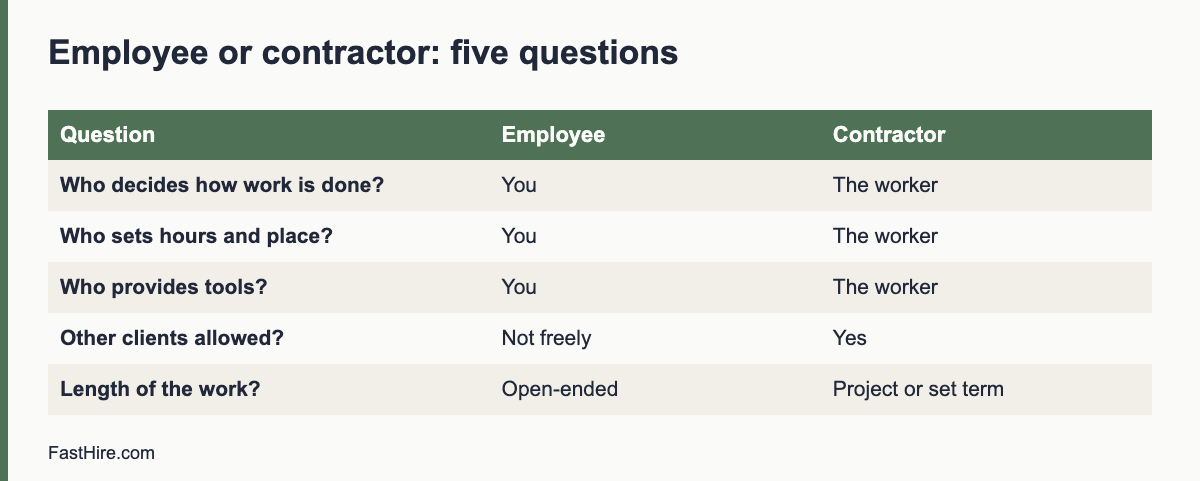
    QuestionPoints to employeePoints to contractor
    Who decides how the work is done?You doThe worker does
    Who sets the hours and the place?You doThe worker does, within a deadline
    Who provides tools and equipment?You doThe worker does
    Can the person work for other clients?Not freelyYes
    Is there a fixed pay each period?Yes, wage or salaryNo, invoice per job or per day
    Who bears the loss if the work goes wrong?You doThe worker does, in part
    Can the person send someone else in their place?NoOften yes
    How long does the relationship run?Open-endedA project or a set term
    Is the person part of your team structure?Yes, with a manager and a titleNo, a supplier outside the team

    No single row decides the question. Authorities look at the overall picture. If most rows point to the left column, treat the person as an employee.

    What the official sources say

    Each region has its own test. Read the official page, not a summary of a summary.

    RegionHow the test worksOfficial source
    United StatesFederal agencies use several tests. The IRS looks at behavioural control, financial control and the type of relationship. The Department of Labor uses an economic reality analysis for wage and overtime law. State tests can be stricter.IRS: independent contractor or employee and DOL: misclassification
    United KingdomThe law uses three groups: employee, worker and self-employed. The group depends on control, obligation to work and personal service.GOV.UK: employment status
    European UnionNational law decides. Tests and protections differ in each member state.Your Europe: hiring and managing staff, then your national authority

    In the UK there is a middle group called “worker”. Workers get some rights, such as the minimum wage and paid holiday, but not all employee rights. Check the GOV.UK page if your role does not fit neatly.

    A decision guide for your first role

    Step 1: Describe the work in one paragraph

    Write what the person will do, for how long, and who decides how. If your paragraph includes “will report to me every day”, “will use our systems”, or “will be available during our hours”, you are describing an employee.

    Step 2: Score the control questions

    Use the table above. Mark each row. Count how many point to each side. Keep this record. It shows you made a reasoned decision.

    Step 3: Check the length and type of the work

    A defined project with a start, an end and a clear deliverable fits a contractor. A role you will need for years, such as customer support or office management, fits an employee.

    Step 4: Price both options

    Use the cost worksheet for the employee. For the contractor, use the quoted fee and add any cost of your own time to manage the work. Compare the full costs, not the day rate against the salary.

    Step 5: Check the official test and confirm with an advisor

    Read the official page for your country. Then ask an accountant or employment lawyer to confirm. One hour of advice before you start is cheap compared with a dispute later.

    Examples (fictional)

    SituationLikely classificationWhy
    A founder needs a new website built in 8 weeks. The designer works from their own studio, sets their own hours and invoices at milestones.ContractorDefined project, own tools, own methods, own business
    A shop needs someone to answer customers every weekday, using the shop’s help desk, following the shop’s scripts, with a fixed weekly wage.EmployeeOngoing, directed work with fixed pay
    A start-up wants a bookkeeper for 4 hours a month who also serves other clients.ContractorSmall, independent service with other clients
    A company calls a person a “freelancer” but requires set hours, a company email address, and a manager to approve their work. They work for no one else.Likely employee, despite the labelControl and dependence point to employment

    These are examples to explain the method. They are not legal conclusions about any real situation.

    Risks of getting it wrong

    If an authority decides that a contractor is an employee, the employer may owe back taxes and contributions, pay for missed holiday, and face penalties. The person may also claim rights that apply to employees. In some countries the person who hired also faces fines. The risk is higher if the label was used to avoid costs. Treat the decision as a legal question, not a budget question.

    There are risks for the worker too. A contractor does not get paid holiday or sick pay in most countries and carries tax and insurance duties. A worker who accepts the wrong label may lose protections they would have had. Be clear and honest about the arrangement in your ad and in your talks with candidates. Do not describe a job as freelance to avoid costs if you will direct it like a normal job.

    How to write the ad for each type

    ItemEmployee adContractor ad
    TitleJob title and levelProject or service name
    PaySalary or wage range, hours, benefitsFee or day rate, project length, payment terms
    HoursWorking hours or shiftsDeadline and deliverables
    ToolsProvided by youProvided by the contractor, or stated in the brief
    Next stepApplication, interviews, offer letterProposal or portfolio review, statement of work

    For an employee role, use our guide on how to write a job ad that attracts the right applicants. For a contractor, write a short brief with the goal, the deliverable, the deadline, the review steps and the payment terms. Treat contractor applicants with the same fairness as employee applicants: use written criteria and evidence, and do not use protected traits to choose. Anti-discrimination law may apply to contractors in some places, so do not assume it does not.

    A contractor agreement checklist

    • Names and legal status of both parties
    • Scope of work and deliverables
    • Deadline and review steps
    • Fee, invoice dates and payment terms
    • Who owns the finished work and any intellectual property
    • Confidentiality terms
    • The contractor provides their own tools and decides how to work
    • The contractor is responsible for their own taxes and insurance
    • How either side ends the agreement
    • Which country’s law applies

    Have a lawyer review a template once. Then reuse it. A signed agreement helps, but it does not override the facts of the relationship.

    When you can change your mind

    Many businesses begin with a contractor and later hire the same person. This is normal when the work grows. Do it openly. End the contractor agreement, offer an employment contract, and set up payroll. Do not keep both arrangements running at once for the same work. If you begin as an employer and then want to move someone to a contractor model, take legal advice first, because this can be seen as an attempt to avoid employee rights.

    Red flags that a contractor is really an employee

    Review your arrangement every six months. These signs suggest the relationship has moved toward employment.

    Red flagWhat it suggestsWhat to do
    The person works set hours that you chooseYou control timeMove to a deadline-based model or hire as an employee
    You give daily instructions on how to do each taskYou control methodTreat as employee work
    The person uses your email address, title and equipmentThey are part of your teamReview the status; take advice
    The work has run for years with no end dateOngoing needConsider an employment contract
    The person has no other clientsDependence on youReview the status; take advice
    You pay a fixed monthly amount regardless of outputWage-like payMove to milestone or invoice pay, or hire as an employee

    One red flag alone does not prove anything. Several together are a signal to act. Document your review and the reasons for your decision.

    Questions to ask a possible contractor

    Use the same questions for every contractor you consider. This keeps the process fair and gives you evidence for your choice.

    1. Describe a similar project you delivered. What was the goal, your method and the result?
    2. Which tools and software will you use, and who pays for them?
    3. Who else do you work for, and how will you manage your time between clients?
    4. What is your fee, what does it cover, and what costs extra?
    5. How do you handle changes to the scope?
    6. Can you share a link or file that shows your work?
    7. What insurance do you hold?
    8. How do you prefer to report progress?

    Score the answers against a short written list, as you would for an employee. A simple guide is in our article on the interview scorecard. Ask each person the same questions, and write down the evidence for each answer.

    Switching from contractor to employee: a short plan

    1. Tell the contractor in writing that you plan to offer employment. Give a date.
    2. Agree a notice period on the contractor agreement.
    3. Prepare an offer letter and an employment contract. Take legal advice for the first one.
    4. Register as an employer and set up payroll before the first day.
    5. Check right-to-work rules for the person, as for any new employee.
    6. End the contractor agreement on the day the employment starts.
    7. Record the change and the reasons.

    This plan keeps the change clean and avoids a period in which the person is both. If the person was truly a contractor before, nothing was wrong. If the person worked like an employee for a long time, take advice about any past tax or pay duties.

    Frequently asked questions

    Can I just call someone a contractor to save money?

    No. The real working relationship decides, not the label. If the person works like an employee, authorities can treat them as one and charge back taxes and penalties.

    Is a part-time employee the same as a contractor?

    No. A part-time employee works fewer hours but is still an employee, with the same rights in proportion to hours. A contractor runs their own business.

    What is the difference between a worker and an employee in the UK?

    Workers have some rights, such as minimum wage and paid holiday, but fewer than employees. The GOV.UK employment status page explains the three groups.

    Do anti-discrimination rules apply to contractors?

    In many places the rules reach beyond employees. Do not assume contractors are outside the law. Check the rules for your country.

    Who should I ask if I am unsure?

    An employment lawyer or an accountant who knows your country. Bring your description of the work and the table from this guide.

    Related guides

    This is general information, not legal advice.
  • How to make your first hire: a step-by-step plan for founders

    How to make your first hire: a step-by-step plan for founders

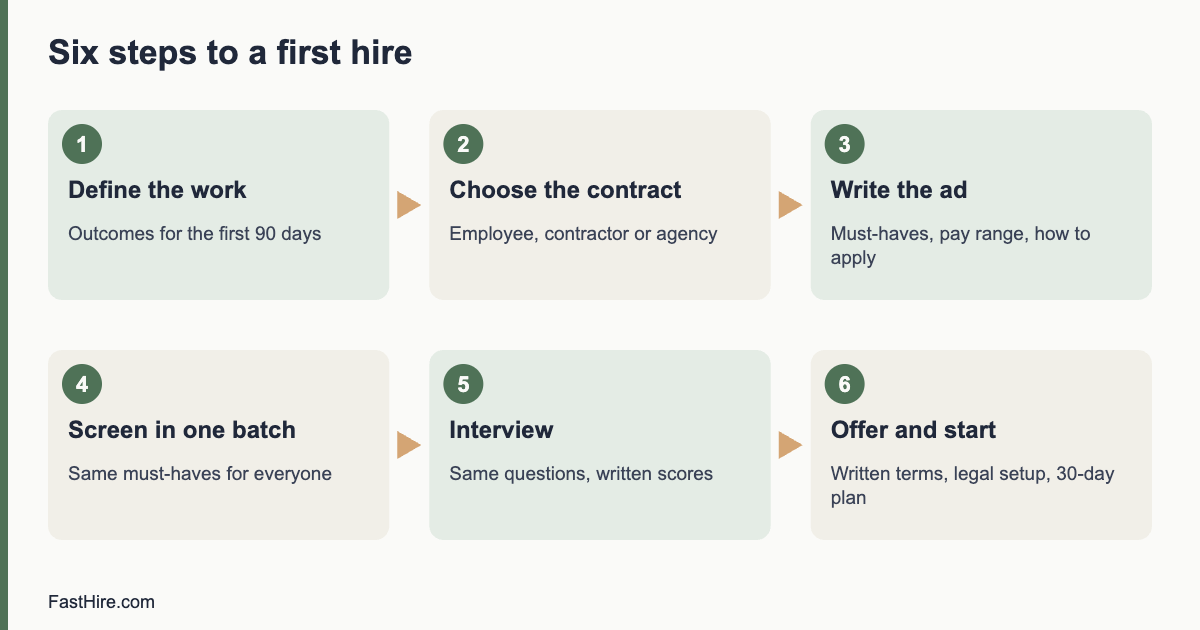
    To make your first hire, start with the work, not the person. Write down what the role must achieve in 90 days, choose the right contract type, publish a clear job ad, compare every applicant against the same must-haves, interview with the same questions, and confirm the offer in writing. This guide walks through each step for founders in the US, the UK and the EU.

    Key takeaways

    • Define the outcomes first. A role you cannot describe in five sentences is not ready to advertise.
    • Decide employee, contractor or agency before you write the ad. The choice changes the law that applies.
    • Set three to five must-haves and judge every applicant against the same list.
    • Use the same interview questions for every candidate and write down evidence, not impressions.
    • Check right to work, give written terms and register as an employer before day one.
    x

    Step 1: Decide whether you really need to hire

    A first hire is a long commitment. Before you advertise, check that the work is regular, that it will not disappear in three months and that you can pay for it. Ask three questions.

    1. What outcome is missing today? Describe it as a result, for example “customer emails answered within one working day”, not as a job title.
    2. Could a tool, a process change or a short contract cover it? If yes, try that first.
    3. Can you pay the full cost for at least a year? Salary is only part of the cost. Add employer taxes, insurance, equipment, software and your own time to train the person.

    If the answers point to a permanent role, continue. If the need is short or uncertain, read the section on contractors below.

    Step 2: Define the role in one page

    Most weak hires start with a vague role. Write a one-page brief before you write any ad. It should contain four parts.

    • Purpose: one sentence on why the role exists.
    • Outcomes: three to five results the person should deliver in the first 90 days.
    • Tasks: the regular work, in order of time spent.
    • Working conditions: location, hours, pay range and who the person reports to.

    Here is a short before-and-after example for a small online shop.

    Weak versionStronger version
    Customer service star wantedAnswer customer emails and chats within one working day, resolve returns, and report the three most common complaints each month
    Must be a fast learner and a team playerMust have 1 year or more of customer support work, paid or unpaid, and be able to write clear replies in English
    Competitive salarySalary range: [your range] per year, 4 days in the office, 1 day remote

    The stronger version tells candidates what the job is. It also gives you something to check each application against. For more on separating essential skills from preferences, see Must-haves vs nice-to-haves: cutting your applicant pile without unfair filters and How to write job requirements candidates can actually check themselves against.

    Step 3: Choose the contract: employee, contractor or agency

    The contract type decides your legal duties, so decide before you advertise. The table gives a first view. It is not a test, because the rules differ by country and by the facts of each case.

    OptionBest whenMain risk
    EmployeeThe work is regular, you direct how and when it is done, and you want a long-term relationshipFull employer duties: payroll, insurance, notice and dismissal rules
    Independent contractor or freelancerThe work is a defined project and the person runs their own businessMisclassification: if the facts look like employment, authorities can treat the person as an employee
    Agency or temporary workerYou need short-term cover or a fast startHigher cost per hour and less control over who arrives

    Each country looks at the real working relationship, not the label in the contract. In the US, the Department of Labor explains how it tells employees from independent contractors in its guidance on misclassification. In the UK, GOV.UK sets out the main employment statuses: worker, employee and self-employed or contractor. In the EU, rules sit mainly at national level, so check the law of the country where the person will work.

    Step 4: Set the budget and the pay range

    Work out the full cost before you promise a number. Use a simple sheet with these lines: base pay, employer taxes and social contributions, pension or retirement contribution where required, insurance, equipment, software, recruitment costs and training time. Tax and contribution rates change, so take them from your tax authority for the current year.

    Set a pay range and show it in the ad. Some US states and some countries require pay information in job ads or on request, and more rules are coming in the EU. Publishing a range also saves time, because applicants who cannot accept it do not apply. Check the rules in the place where the person will work.

    Step 5: Write a clear job ad

    A good ad answers the questions a candidate has before they apply: what will I do, what do I need, what do I get, and how do I apply. Keep it under 500 words. Here is a short sample you can adapt.

    Customer Support Assistant, Greenfield Home Goods (small online shop, 6 people)

    What you will do: answer customer emails and chats within one working day, process returns, and tell us each month what customers ask about most.

    What you need: at least 1 year of customer support work (paid, unpaid or volunteer), clear written English, and comfort learning new software.

    Nice to have: experience with a shop platform.

    What we offer: [pay range] per year, 25 days of holiday, 4 days in our office and 1 day from home.

    How to apply: send your resume or CV and a few lines on a time you solved a customer problem. We reply to every application within 10 working days.

    Avoid wording that points to a protected group, such as “young and energetic” or “native speaker”. The US Equal Employment Opportunity Commission explains that job ads must not favour or discourage people because of protected traits, on its page about prohibited employment policies and practices. In the UK, Acas has practical advice on recruiting fairly, including advertising a job.

    Step 6: Find candidates

    You do not need a large budget. Start with channels where your kind of candidate already looks.

    • Your own website and social accounts. Ask friends and customers to share the ad.
    • One or two job boards that fit your sector and country.
    • Public employment services. In the UK, Jobcentre Plus help for recruiters is listed on the GOV.UK recruiting and hiring page.
    • Referrals. They are quick, but they tend to bring people who look like your current team, so also advertise openly.

    Tell people when the ad closes and when they will hear from you. A closing date lets you screen in one batch, which is faster than reading each application on the day it arrives.

    Step 7: Screen applications in one batch

    Screening means comparing each application with your must-haves. It does not mean looking for reasons to reject. Use a simple three-column sheet: the must-have, what the resume or CV shows, and a yes, no or unclear.

    1. Read each application once against the must-haves only. Mark each as yes, no or unclear.
    2. Note the line in the CV that supports each yes. If you cannot point to a line, mark it unclear.
    3. Invite everyone with all yes marks. For unclear marks, send one short question by email.
    4. Keep the sheet. It is your record of why you made each decision.

    Do not reject people for things that are not requirements, such as a gap in work history, an unusual career path or a degree you listed only as “nice to have”. FastHire is being built around this idea: show each requirement next to the exact CV passage that supports it, so a person can check the evidence quickly. FastHire is coming soon. It does not rank, score or reject candidates. People make every decision.

    Step 8: Interview with the same questions for everyone

    A structured interview means each candidate gets the same questions in the same order, and you score the answers against the same scale. It is fairer and easier to compare than a free conversation. Prepare six to eight questions tied to the outcomes in your brief. A sample set:

    • Tell me about a time you had to learn a new tool quickly. What did you do first?
    • Describe a customer or colleague who was unhappy. What did you say and what happened?
    • How do you decide what to do first when three tasks are urgent?
    • What would you want to know in your first week?
    • Give an example of a mistake you made at work. What did you change afterwards?

    Score each answer from 1 to 4 using notes you write straight after the interview: what the person said they did, not how they made you feel. Do not ask about age, family plans, health, religion or similar topics. If a candidate raises a health need or a disability, ask only what adjustment would help them do the interview or the job.

    Step 9: Check references and right to work

    Ask permission before you contact a referee. Ask each referee the same questions, for example: “What was this person responsible for? How did they handle pressure? Would you work with them again?”

    Right to work checks are a legal duty in every country, and the method differs.

    • US: complete Form I-9 for every new employee. The IRS page on hiring employees covers Form I-9 and the Form W-4.
    • UK: check the applicant’s right to work before they start, following the steps in the GOV.UK guide: an online share code or original documents, with copies and the date of the check kept.
    • EU: rules are national. Check with the labour ministry or employer authority in the country of employment.

    Step 10: Make the offer and set up the legal basics

    Make the offer by phone first, then confirm it in writing. Include the job title, start date, pay, working hours, location, notice period and any probation period. Give a date by which you need an answer.

    Then complete the basic setup for your country.

    CountryWhat to do before or on day one
    USGet an Employer Identification Number if you do not have one, collect the Form W-4 and complete Form I-9. See the SBA guide to hiring and managing employees. Check your state for extra rules, such as new-hire reporting and workers’ compensation insurance.
    UKRegister as an employer with HMRC before the first payday, using the GOV.UK registration page. Give a written statement of employment particulars. The core statement is due on the first day and the wider statement within two months, according to GOV.UK. Arrange employers’ liability insurance.
    EUGive the employee written information about the main terms of work. Directive (EU) 2019/1152 sets minimum rules on transparent and predictable working conditions, and each member state applies it through national law. Register the employee with the national tax and social security bodies.

    Step 11: Plan the first 30 days

    The start of the job is where a good hire is made or lost. Prepare before day one: equipment, accounts, a named buddy and a plan for week one. A simple structure works.

    • Day one: welcome, tools, introductions and the one-page brief.
    • Week one: shadow the work, finish a first small task and hold a short end-of-week check-in.
    • Day 30: review against the outcomes in the brief. Agree what to do in the next 60 days.

    Use the brief you wrote in step 2. If you wrote clear outcomes, the review is a conversation, not a guess.

    Common mistakes in a first hire

    • Hiring someone like yourself. Choose for the work that is missing, not for a similar personality.
    • Making the ad a wish list. A long list of requirements discourages good applicants and makes screening harder.
    • Skipping written notes. Memory is unreliable, especially after five interviews.
    • Waiting for the perfect candidate. A candidate who meets all the must-haves is a strong candidate.
    • Ignoring local law. The rules about contracts, probation and notice differ by country and even by state.

    A simple timeline

    For a small team, plan roughly three to six weeks from advertising to offer if you move steadily. That is two weeks to advertise and collect applications, one week to screen, one to two weeks to interview, and a few days for references and the offer. The notice period of the person you choose may add more weeks before they start. Your market and the role will change these numbers, so treat them as a planning aid and not a benchmark.

    Frequently asked questions

    How long does it take to make a first hire?

    Plan for several weeks from the ad to the offer, and add the notice period of the person you choose. A closing date and batch screening shorten the process more than posting in more places.

    Should my first hire be an employee or a contractor?

    Choose an employee when the work is regular and you direct how it is done. Choose a contractor for a defined project where the person runs their own business. Classification depends on the real relationship, so check your country’s rules.

    Do I need an HR person to make a first hire?

    No. You need a clear role, a fair and consistent process and the legal basics for your country. Written notes and the same questions for every candidate give you most of what an HR team would add.

    What should I include in a first job ad?

    Include what the person will do, the must-haves, the pay range, the location and working pattern, and how and when to apply. Leave out wording that points to age, sex, race or other protected traits.

    Can I use AI tools to screen applicants?

    Some tools help you read applications faster. The decision should stay with a person, and local rules may apply, so check the law where you hire.

    Related guides

    This is general information, not legal advice.
  • How to assess skills with a work sample test

    How to assess skills with a work sample test

    A work sample test asks a candidate to do a short piece of real job work, then scores the result against a written guide. To use one well, test only the skills the job needs, keep the task short, give clear instructions, use a made-up case, pay for long tasks, score blind to name where possible, and give every candidate the same task, time and support.

    Key takeaways

    • Choose a task that mirrors a real part of the job and tests a must-have you cannot judge from the CV.
    • Keep it short: 30 to 90 minutes in most cases. Pay if it takes longer or looks like real work for your business.
    • Write the brief, the time limit and the scoring guide before you send it to anyone.
    • Use a made-up case. Never use a task to get free work.
    • Offer adjustments and an alternative format. Score every candidate on the same guide.
    x

    What a work sample test is, and when to use it

    A work sample puts the candidate in a small version of the job. A bookkeeper reconciles a short set of fictional accounts. A support agent answers three sample customer messages. A designer improves a layout brief. A manager plans a short schedule with conflicts. Because it shows what the person can do, it can give stronger evidence than a conversation about what they have done.

    Use a work sample when: the must-have is a skill that can be shown in an hour or less; the CV and interview cannot confirm it; and you are down to a few finalists. Do not use one as a first filter for all applicants. That asks too much time from too many people. See our interview plan guide for where it fits in the stages.

    RolePossible taskSkill testedSuggested time
    Customer supportReply to three fictional customer messages with different problemsWritten clarity, empathy, policy use30 to 45 minutes
    Operations coordinatorPlan a week of deliveries from a short list with conflictsPlanning, priorities45 minutes
    Marketing coordinatorWrite a short email and a subject line for a given audience and goalWriting, audience focus45 minutes
    Finance assistantFind errors in a small sample sheetAccuracy, method45 to 60 minutes
    DeveloperFix a small bug in a given code sample, or review a short pull requestReading code, reasoning60 to 90 minutes
    ManagerPrepare a one-page plan to handle a fictional staffing gapJudgement, planning60 minutes

    Design the task in seven steps

    Step 1: Choose the must-have

    Pick one to three must-haves from your role brief. The task must tell you something new about each. If the task tests many things at once, it is hard to score fairly.

    Step 2: Write a made-up case

    Create a short scenario with fictional names and data. Make it realistic but not secret. Do not use real customer data. Do not ask for work that you will use in your business.

    Step 3: Write the brief

    State the goal, the materials provided, the time limit, the format of the answer, the tools allowed and how you will score. Use short sentences. State that the task is not a promise of a job.

    Step 4: Write the scoring guide

    Criterion1: weak2: partial3: good4: strong
    AccuracyMajor errorsSeveral errorsMinor errorsNo errors; checks shown
    ClarityHard to followPartly clearClearClear and well structured for the reader
    MethodNo method visibleSome steps visibleSound methodSound method and trade-offs explained
    Use of the briefIgnores the briefPartly follows itFollows itFollows it and notes assumptions

    Step 5: Test the task

    Ask a current employee to do the task. Time them. Check whether the instructions are clear, and whether a good answer exists within the time. Adjust the scope or the time limit.

    Step 6: Plan fairness

    Give every finalist the same brief, time and support. Offer extra time or a different format when a person needs an adjustment, such as a screen reader, extra time or a spoken alternative. Do not make the task depend on tools or access that only some candidates have.

    Step 7: Score and give feedback

    Score each answer against the guide, ideally with names hidden. Two scorers on a sample reduce errors. Record the scores in the scorecard. Send feedback to all finalists. See how to give fast interview feedback.

    Pay, time and respect for candidates

    Task lengthSuggested approachReason
    Up to about 30 minutesDo it in the interview, supervised or as a live exerciseLow burden; no payment needed
    30 to 90 minutesOffer a time slot, or a take-home with a clear time limit; do not expect more time to be spent than statedModerate burden; many candidates work full time
    More than 90 minutesPay a fair fee, or reduce the taskLong tasks can be unpaid work, and exclude people with limited free time
    Anything that creates value for your businessPay, or do not askUnpaid work may be unfair and, in some places, unlawful

    The rules on paid and unpaid trial work differ by country. In the US, the Department of Labor explains when unpaid work may break wage laws in its FLSA pages. In the UK, check the minimum wage rules on GOV.UK. In the EU, each country has its own rules. When in doubt, pay for the time. This is general information, not legal advice.
    Templates

    Brief to the candidate

    Hello [Name],

    As the next step, we would like you to do a short exercise. It shows us how you work on a task similar to the job. It is a made-up case with fictional data.

    Time: about [60] minutes. Please do not spend more than [75] minutes.
    What to do: [two or three sentences].
    What we give you: [file or text].
    What to send back: [format] by [date and time].
    How we score: [clarity, accuracy, method and use of the brief]. Every candidate gets the same task and the same guide.
    Adjustments: if you need extra time, a different format or any other support, please reply and we will arrange it.
    Pay: [fee, or “this exercise is unpaid because it takes under 60 minutes”].

    Thank you,
    [Name]

    Feedback after the task

    Hello [Name],

    Thank you for completing the exercise. We scored it against the guide we sent. Your strongest point was [specific point]. The area where we saw less evidence was [specific point]. We will contact you by [date] with a decision on the next step.

    Best wishes,
    [Name]

    A worked example (fictional)

    This example is invented. A team hires a customer support lead. The must-have is “handles a hard customer message with clarity and care”. The brief gives three made-up messages: a late parcel, a wrong item and an angry complaint. The candidate has 45 minutes. Two scorers use the guide above. Candidate A writes three polite but generic replies, and scores 2 on method. Candidate B writes clear replies, explains the steps she would take internally and notes assumptions, and scores 4 on method. The scores go into the scorecard next to the interview scores. In the debrief, the group sees that the interview scores were similar, and the task separates the two candidates on a must-have that matters. The evidence is clear, and the decision is easy to explain.

    Risks and how to reduce them

    RiskWhy it mattersControl
    BiasScorers react to style, names or handwritingBlind scoring, a written guide, two scorers on a sample
    Unfair accessSome people lack time, tools or a quiet spaceOffer time options, tools and adjustments
    Free workThe task looks like real workMade-up case; pay for long tasks
    Over-testingToo many tasks drive away good peopleOne task, only for finalists
    Cheating or outside helpTake-home tasks may be done with helpAsk follow-up questions about the answer in the interview
    Weak link to the jobThe task does not match real workAsk current employees to check it

    Use the task as one piece of evidence, together with the interview and references. Do not let it decide alone. Review the task after each search: did the scores relate to later performance? If not, change the task.

    Example tasks with scoring notes

    Task (fictional)What a strong answer showsCommon weak answer
    Plan deliveries for five days with three vehicles and two driver absencesA clear schedule, explicit assumptions, a back-up plan and a note on which orders may slipA schedule that ignores the absences or has no assumptions
    Write a reply to a customer who received a damaged itemAcknowledges the problem, states what will happen and when, is short and politeLong apology with no clear action
    Review a short budget sheet with three deliberate errorsFinds the errors, explains each, and suggests how to prevent themFinds one error and rewrites the sheet without explanation
    Plan a 30-minute team meeting to resolve a conflict between two colleaguesAgenda, ground rules, fair process, follow-up actionA plan that assigns blame in advance

    Notice that the strong answer also shows reasoning. If the task allows a short note on assumptions, you can see how the person thinks, not only the final output. Add a line to the brief: “Please add a short note with any assumptions you made.”

    Using the task in the interview

    Ask each finalist to talk through the answer for ten minutes. Ask: What was the hardest part? What would you do with more time? What did you assume? This helps you check that the candidate did the work, and shows how they respond to questions. It also gives people who write less well a chance to show their thinking in speech. Score the answer and the talk-through on separate lines so that you can see each clearly.

    What to do with scores

    Treat the work sample as one input. Add the scores to the scorecard, next to the interview scores and the reference notes. Look at the pattern across methods. If a candidate does well in the interview but poorly on the task, ask why. The task might have been unclear, or the interview might have covered a different part of the skill. Do not discard either piece of evidence without a reason. Record your reasoning in the decision record. See how to run a debrief for a method to resolve conflicting evidence.

    Keep a library of tasks. After each search, save the brief, the scoring guide and notes about what worked. Remove any task that candidates found unclear. Replace any task whose answers can be found online. Over time you build a set of tested tasks for each role family, and the next search starts faster and fairer.

    Frequently asked questions

    Should work sample tests be paid?

    If they take more than about an hour, or if they create value for your business, pay. For short tasks done in the interview, payment is not usual. Check local wage rules.

    How long should a work sample be?

    Usually 30 to 90 minutes. Longer tasks reduce the number of people who can apply and can feel unfair.

    Can I use a real problem from my business?

    Avoid it. Use a made-up case so that you are not taking free work and no confidential data is shared.

    What if a candidate refuses to do the task?

    Ask why, and offer an alternative if they have a good reason, such as a disability or a time limit. Do not assume lack of interest.

    Is a work sample better than an interview?

    Each tests different things. A task shows what the person can do now. An interview shows past behaviour and how the person thinks. Use both when needed.

    Related guides

    This is general information, not legal advice.

  • Interview scorecard template with a worked example

    Interview scorecard template with a worked example

    An interview scorecard is a one-page form where each interviewer rates every candidate on the same criteria, with a short note of evidence for each rating. Build it from the role brief: list the must-haves and four to six competencies, define a rating scale with anchors, score alone straight after each interview and compare scores in the debrief. A scorecard turns a feeling into something you can discuss and check.

    Key takeaways

    • Build the scorecard from the role brief, not from a generic template.
    • Separate must-haves (pass or not yet shown) from competencies (rated 1 to 4 or 1 to 5).
    • Add a line of evidence for every score. A score with no evidence does not count.
    • Score alone, immediately after the interview and before any discussion.
    • Use scores to structure the decision, not to replace judgement. A person decides.
    x

    What a good scorecard does

    A scorecard has four jobs. It reminds interviewers what to look for, so that they do not drift into talk about hobbies and shared friends. It gives each candidate the same measuring stick. It records the reasons for a decision. And it makes the debrief shorter, because the first ten minutes of argument are replaced by a table.

    A scorecard does not make a decision for you. Scores are a summary of what people noticed. If the scores say one thing and your reading of the evidence says another, ask why, and write the answer down. In some places, using automated scoring tools triggers specific legal duties, so keep the scorecard a human tool, completed and understood by the interviewer.

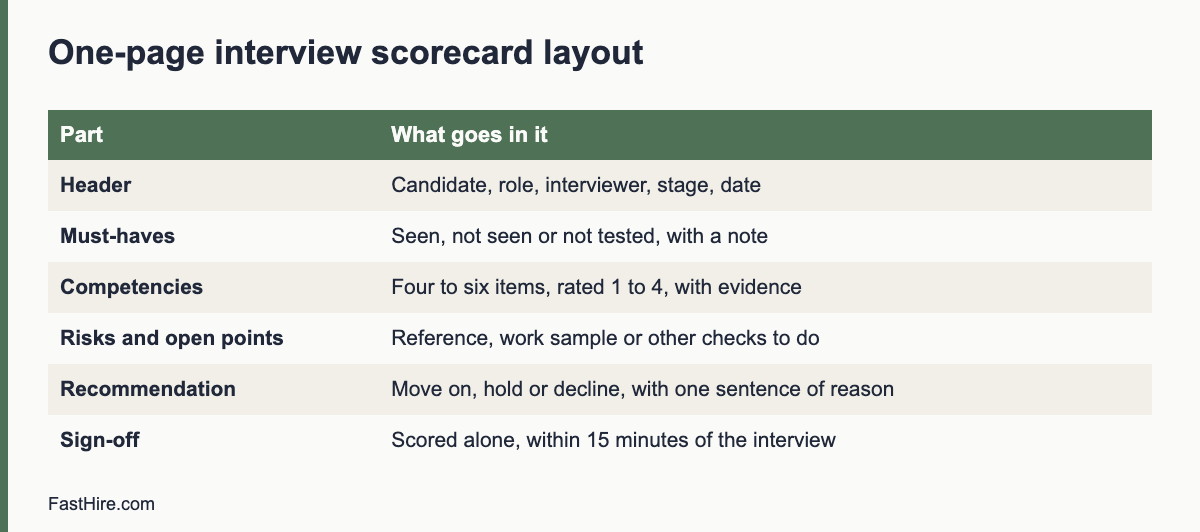
    The layout of a one-page scorecard

    PartWhat goes in itWhy
    HeaderCandidate, role, interviewer, date, interview stageTraceability
    Must-havesEach must-have from the brief with “seen”, “not seen” or “not tested” and a noteKeeps the decision tied to the requirements
    CompetenciesFour to six competencies, each rated 1 to 4 with a line of evidenceCompares candidates on skills the interview tested
    Risks and open pointsAnything to check, for example a reference or a work sampleMakes the next step clear
    RecommendationMove on, hold or decline, with one sentence of reasonForces a position
    Sign-offInterviewer name and time of scoringShows that the score was made alone and promptly

    Step 1: Choose what to score

    Start with the role brief. Copy the must-haves into the top part of the scorecard. These are not rated. They are either seen in the application or interview, not seen, or not yet tested. If a must-have is not seen, the candidate does not move forward unless you have a good reason and write it down.

    Then pick four to six competencies that the interview can test. They should be connected to outcomes in the brief. For a project coordinator, these might be planning, communication, problem solving, reliability and working with others. Avoid vague items such as “attitude” or “energy”. If you cannot write an anchor for an item, remove it.

    Step 2: Define the rating scale

    Use a 1 to 4 scale. It avoids the neutral middle and keeps the form simple. Write a general meaning for each number and then, for each competency, write one line for what a 1 and a 4 look like.

    ScoreGeneral meaning
    1Little or no evidence, or evidence of poor practice
    2Some evidence, but incomplete or inconsistent
    3Clear evidence that meets what the role needs
    4Strong evidence that clearly exceeds what the role needs

    Add one rule: a score of 4 must be backed by a specific example. This reduces score inflation, which is the habit of giving high scores to candidates you like.

    Step 3: Add weights only if you can explain them

    Not all competencies matter equally. You can give a competency more weight, for example a double weight for the one that matters most for the 90-day outcomes. Do this before the first interview and write the reason in the brief. Do not change weights after you meet candidates. If weights make you uneasy, skip them and compare the profile of scores instead of a total.

    A worked example

    This example is fictional. It shows how two interviewers might score two candidates for a project coordinator role. The role brief has three must-haves: two years of coordination work, clear written English and working knowledge of a project tool. Five competencies are scored from 1 to 4, and “planning” has a double weight because on-time delivery is the main outcome.

    Competency (weight)Candidate A: score and evidenceCandidate B: score and evidence
    Planning (x2)3: described a 12-week plan with milestones and a weekly check4: described adjusting a plan when a supplier failed, with dates and impact
    Communication (x1)4: gave a clear, structured answer to every question3: clear, but needed prompts to give detail
    Problem solving (x1)3: solved the example by splitting the task3: used a similar approach and added a check
    Reliability (x1)3: gave a specific example of covering for a colleague2: example was vague about the outcome
    Working with others (x1)3: described a conflict and how it ended3: described a joint deadline with a clear role split
    Weighted total (max 24)3×2 + 4 + 3 + 3 + 3 = 194×2 + 3 + 3 + 2 + 3 = 19

    The totals are equal at 19. This is exactly where a scorecard helps. Instead of a vague argument, the panel can see that Candidate A is stronger in communication and reliability, and Candidate B in planning. The panel can ask: which strength matters more for the first 90 days? It can also decide to run a short work sample on planning for Candidate A, or to check a reference on reliability for Candidate B. The scorecard did not decide. It showed where to look.

    Step 4: Score alone and promptly

    Each interviewer fills in their own scorecard within 15 minutes of the interview, before they talk to anyone else. Memory fades quickly, and the first strong opinion in the room tends to pull everyone with it. Collect the scorecards before the debrief starts. See our guide on structured interviews for question design and anchors.

    Step 5: Compare in the debrief

    1. Put every interviewer’s scores in one table, with the evidence next to each.
    2. Look first at the must-haves. Is any not seen for a candidate?
    3. Look at large differences between interviewers. Ask for the evidence behind each. A big gap often means the interviewers saw different things or read the anchors differently.
    4. Agree the next step, such as a reference check or a short work sample, to settle open points.
    5. Record the decision and the reason in two sentences.

    What to do about common problems

    ProblemWhat it looks likeFix
    Score inflationAlmost every candidate gets 3s and 4sRequire an example for every 4. Review the average per interviewer.
    Halo effectOne strong answer lifts every scoreScore one competency at a time, with the evidence in front of you.
    Similarity biasHigher scores for people who are like the interviewerAsk: what is my evidence? Have a second interviewer score.
    Late scoringScores written the next dayBlock 15 minutes after each interview in the calendar.
    Weighting driftWeights change after meeting candidatesFix weights before interviews and write them in the brief.
    Over-reliance on totalsThe highest total wins by one pointRead the evidence. Treat small differences as ties.

    Keeping the scorecard fair and lawful

    Scorecards help show that you used job-related criteria. They only help if the notes are factual. Write what the candidate said or did. Do not write comments about age, sex, race, religion, disability, family plans or similar topics. The US Equal Employment Opportunity Commission explains the main limits on its page about prohibited employment policies and practices. The Acas page on recruitment explains the position in Great Britain.

    Scorecards and notes are personal data. In the UK and the EU, tell candidates how you use their data and delete it when you no longer need it. The Information Commissioner’s Office explains the rules in its guidance on recruitment and selection. A candidate may ask to see notes about them, so write notes that you would be comfortable sharing.

    A blank scorecard to copy

    Interview scorecard
    Candidate: ______ Role: ______ Interviewer: ______ Date and time of scoring: ______

    Must-haves (seen / not seen / not tested, with a note)
    1. ______
    2. ______
    3. ______

    Competencies (score 1 to 4 and evidence; weight in brackets)
    1. ______ (x__): Score __ Evidence: ______
    2. ______ (x__): Score __ Evidence: ______
    3. ______ (x__): Score __ Evidence: ______
    4. ______ (x__): Score __ Evidence: ______
    5. ______ (x__): Score __ Evidence: ______

    Risks and open points: ______
    Recommendation: move on / hold / decline
    Reason in one sentence: ______

    FastHire is being built so that the evidence behind the must-haves is easy to see. It shows each job requirement next to the exact CV passage that supports it, so the interview can concentrate on what the CV cannot show. FastHire is coming soon. It does not rank, score or reject candidates. People make every decision.

    Sample competencies for common roles

    Use these as starting points, then change them to match your own role brief. Keep to four to six.

    RolePossible competencies to scoreEvidence to ask for
    Customer support agentClear writing, patience under pressure, problem solving, learning new tools, reliabilityA real ticket they handled; how they replied; what they learned
    Sales representativeListening, planning the week, handling objections, honesty with customers, follow-throughA deal won and a deal lost; what they did differently next time
    Software developerProblem solving, code quality, collaboration, learning, communication of trade-offsA project they built; a decision they changed after feedback
    Operations coordinatorPlanning, accuracy, communication, prioritising, working with suppliersA schedule they ran; a problem they caught before it grew
    Team leadCoaching, fairness, decision making, handling conflict, delivering outcomesA person they helped improve; a hard decision and the result

    Using scorecards across several rounds

    If you run more than one interview, give each round a different focus and its own scorecard, but keep the must-haves the same. For example, round one tests communication and role knowledge, and round two tests planning and working with others. Avoid asking the same question twice, because a repeated question tests memory, not skill. Before the final round, gather all scorecards into one table with the evidence, and look at the whole picture instead of the last interview.

    When a candidate does a work sample, score it with the same 1 to 4 scale and the same anchors for every candidate. Ask two people to score it separately, and compare. A short rubric written before the task is set, such as “includes a clear summary”, “numbers are correct” and “next steps are listed”, keeps the scoring objective.

    Keep it short enough to use

    A scorecard that takes 30 minutes to fill in will be filled in badly or late. Aim for 10 to 15 minutes. If interviewers complain, remove competencies rather than evidence lines. Evidence is what makes the scorecard worth keeping. A short form with real notes is better than a long form with ticks.

    Frequently asked questions

    What should an interview scorecard include?

    The candidate and role, the must-haves, four to six competencies with a rating scale and a line of evidence each, risks and open points, a recommendation and a sign-off with the time of scoring.

    Should I use a 1 to 5 or a 1 to 4 scale?

    Both work. A 1 to 4 scale avoids the neutral middle score. Choose one scale and use it for every candidate.

    Do I need weights?

    Not always. Use weights only when one competency clearly matters more for the 90-day outcomes, and set them before the first interview.

    Can candidates see my scorecard?

    In some countries, candidates can ask for the personal data you hold about them, and notes may be included. Write notes that are factual and that you could explain.

    What if two candidates have the same total?

    Look at the evidence and at where each is strongest. Decide which strength matters more for the outcomes in the brief, or use a short work sample or reference to settle the difference.

    Related guides

    This is general information, not legal advice.
  • How to run a first interview for a small business: questions and scorecard

    How to run a first interview for a small business: questions and scorecard

    To run a first interview for a small business, prepare six to eight questions tied to the must-haves of the role, ask every candidate the same questions in the same order, take notes, and score each answer on a simple scale straight after the interview. Keep it to 30 to 45 minutes, leave time for the candidate’s questions, and explain what happens next.

    Key takeaways

    • Prepare before the interview: the must-haves, six to eight questions, a scorecard and a note sheet.
    • Ask every candidate the same core questions. Add follow-ups only to get more detail.
    • Ask for real examples of past work, and for how the person would handle a realistic task.
    • Score right after the interview, from your notes, before you compare with anyone.
    • Never ask about protected traits such as age, family plans, health, religion or origin.
    x

    Why a first interview needs a plan

    In a small business the owner often interviews alone and on instinct. The conversation feels friendly, but different candidates get different questions, and the person you like most often wins. A plan fixes that. It does not make the interview cold. It lets you listen, because you do not need to invent the next question.

    Research on selection methods generally finds that structured interviews predict job performance better than unstructured ones. For a short, plain explanation, see our guide on structured interviews.

    The 40-minute agenda

    MinutesPartWhat you do
    0 to 5WelcomeGreet the person, explain the agenda and the time, offer water, say that you will take notes
    5 to 10Business and roleDescribe the business, the role and the team in two minutes. Ask if anything is unclear
    10 to 30Core questionsAsk six to eight prepared questions. Use the same order for everyone
    30 to 35Candidate questionsInvite questions and answer honestly
    35 to 40CloseExplain the next steps, the date you will reply and thank the person

    If the candidate needs a longer time or a different format, for example because of a disability, make the change. See the Acas page on recruitment for UK guidance on fair processes, and the EEOC small business resource centre for US basics.

    The question bank

    Choose six to eight questions from this list. Match them to the must-haves in your role brief. Each question asks for evidence from real experience or a realistic task.

    AreaQuestionWhat to listen for
    MotivationWhy are you interested in this role at our business?Specific reasons linked to the work, not general praise
    ExperienceTell me about the most relevant work you have done for this role. What did you do yourself?Clear personal contribution, tasks and results
    Problem solvingDescribe a problem at work that you solved. What was the situation, what did you do and what happened?A real situation, steps, result and learning
    CommunicationTell me about a time you had to explain something difficult to a customer or colleague.Clarity, listening, a good outcome
    ReliabilityDescribe a time you had to meet a tight deadline. How did you plan it?Planning, priorities, honest about problems
    TeamworkTell me about a time you disagreed with a colleague. How did it end?Respect, facts, a resolution
    LearningWhat is something new you learned in the last year? How did you learn it?Curiosity and method
    Role-specific taskHere is a realistic example: [short case]. What would you do first, and why?Sensible steps, questions asked, good judgement
    Practical fitThese are the hours and the place. Do they work for you?A direct answer. Do not ask why not.

    For more questions and a scoring guide, see our article on behavioural interview questions.

    The scorecard

    Create a table with the must-haves in rows and a 1 to 4 scale. Define each level in words before you interview anyone. Fill it in right after the interview.

    ScoreMeaningExample for “communicates clearly in writing”
    1No evidence or poor evidenceCould not give an example; answer unclear
    2Some evidence, with gapsGave a general example with little detail
    3Good evidenceClear example, relevant to the role, with a result
    4Strong evidenceClear example, strong result, shows skill beyond the need of the role

    Add a column for notes with the exact words or facts that led to the score. At the end, add the scores and read the notes. Do not use the total as the decision. Use it as a prompt for your discussion and make a clear, reasoned choice. A fuller version with a worked example is in our interview scorecard template.

    How to take notes

    • Write facts and phrases, not opinions. “Reduced late orders from ten per week to two” is a fact. “Seems great” is an opinion.
    • Use a sheet with a box per question. Do not write on the CV only.
    • Tell the candidate that you will take notes, and why.
    • Do not note protected traits or comments on appearance. If the candidate mentions something personal, do not use it in your decision.
    • Keep notes for the period allowed by the rules in your country, and store them securely.

    Questions you must not ask

    Do not ask about age, date of birth, marital status, children or plans for children, pregnancy, health or disability history, religion, ethnic origin, nationality of birth, sexual orientation or political views. These can lead to discrimination claims, and they do not tell you if the person can do the job. If you need to know whether a person can do a task, ask whether they can do the task with or without reasonable adjustments, and describe the task. If you need to check the right to work, do so as the law requires for every person you plan to hire, not only for those who seem foreign to you. Our upcoming guide to what you can and cannot ask will cover the US, UK and EU rules in detail. For basics, read the Acas recruitment page and the EEOC page on prohibited practices.

    After the interview

    1. Score within 15 minutes, while your memory is fresh.
    2. Write the three strongest points and the biggest doubt for each candidate.
    3. Wait until all first interviews are done before you compare. This reduces the effect of the first and last candidate.
    4. Choose the top two or three for a second step, such as a short task or a second conversation.
    5. Send every candidate an outcome by the date you promised.

    Common mistakes

    MistakeResultFix
    Talking for 25 minutes about your businessYou learn little about the candidateLimit your talk to 5 minutes
    Different questions for each personYou cannot compareUse a fixed list
    Asking hypothetical “what would you do” onlyPeople give ideal answersMix with past examples
    Scoring after all interviewsMemory blends the candidatesScore at once
    Choosing the person you would enjoy a coffee withSimilarity biasUse the scorecard as evidence
    No next-step messageCandidates lose trustPromise a date and keep it

    If you also use a short test task, read our upcoming guide on work trials and test tasks to keep them fair and paid where required. For the whole process, our first hire plan shows where the interview fits.

    A worked example of scoring (fictional)

    This example is invented. A small online shop interviews for an operations coordinator. The must-have being scored is “clear written communication”. The question is: “Tell me about a message you wrote to explain a problem to a customer or colleague.”

    Candidate answer (summary)ScoreReason noted
    “I write good emails.” No example when asked a follow-up.1No evidence. The follow-up did not produce a case
    “I once told a customer their parcel was late. I said sorry and sent a new date.” No detail on the result.2Some evidence; no information on how the customer responded or what the person learned
    “A courier lost 40 parcels in a week. I wrote one message to all affected customers with the new dates and a refund option. Only two complained and I replied to both the same day.”3Clear situation, action and result. Relevant to the role
    “I created a template for delay messages that the whole team now uses, and I track replies. Complaints about delays fell after we started using it.”4Strong evidence; the person improved the process and measured the result

    Notice that the score depends on evidence, not on style. A shy candidate with a clear example should score higher than a fluent talker with none. This is one reason a scorecard is fairer than a general impression.

    A short script for the start and the end

    Opening

    “Thank you for coming. This is a 40-minute conversation. First I will tell you about the business and the role. Then I will ask some questions, and the same questions go to every candidate. I will take notes so that I do not miss anything. You can ask your questions at the end. If you need a pause or anything changed, please tell me.”

    Closing

    “Thank you. We are talking to several people this week. I will contact everyone by [date] with a clear answer. If anything changes on your side, such as another offer, please tell me so that I can plan. Do you have any last question?”

    A clear closing respects the candidate’s time. It also gives you a deadline that you must keep.

    If you interview online

    • Send the link, the time zone and the name of the interviewer in advance.
    • Use the same platform and the same length for everyone.
    • Tell the candidate what to do if the connection fails, for example a phone number to call.
    • Do not judge the background, the room or the camera quality. They say nothing about the skill.
    • Allow captions or other adjustments if the candidate asks.

    Adjustments for fairness

    Offer all candidates the chance to ask for changes before the interview. For example: “If you need any adjustment, such as more time, written questions in advance, or a different format, please tell us and we will arrange it.” In the UK, employers must consider reasonable adjustments for disabled applicants. In the US, the Americans with Disabilities Act covers reasonable accommodation for qualified applicants at employers of the required size. Rules differ in each EU country. Check your local rules, and remember that this is general information, not legal advice.
    Prepare yourself: a 10-minute checklist

    • Re-read the role brief and the must-haves.
    • Print or open the CV and mark two things you want to ask about.
    • Print the question list and the scorecard.
    • Block 15 minutes after the interview for scoring.
    • Silence your phone and close other windows.
    • Prepare answers to likely candidate questions: pay range, hours, team, growth, process and timeline.

    Candidates often ask about pay, the first month, how success is measured and why the role is open. Have honest answers ready. If you do not know, say so and say when you will find out. Candidates trust honest answers more than polished ones.

    Frequently asked questions

    How long should a first interview be?

    30 to 45 minutes is enough for most small business roles. Add time for the candidate’s questions.

    How many questions should I ask?

    Six to eight core questions plus follow-ups. More than that leaves little time to listen.

    Should I interview by video or in person?

    Either works if you use the same format for everyone. Offer an alternative if a candidate needs one.

    Can I ask the same questions as another interviewer?

    Yes. When several people interview, use the same question set and compare notes afterwards.

    What if the candidate talks too little?

    Ask a follow-up: “Can you tell me more about what you did yourself?” or “What happened next?” Give a few seconds of silence.

    Related guides

    This is general information, not legal advice.
  • Behavioural interview questions with a scoring guide

    Behavioural interview questions with a scoring guide

    Behavioural interview questions ask candidates to describe what they actually did in a past situation, for example “Tell me about a time you had to learn something quickly.” The answers show how a person works. To use them well, choose four to six skills from your role brief, ask the same questions of every candidate, listen for the situation, the person’s own actions and the result, and score each answer against written anchors.

    Key takeaways

    • Use behavioural questions to test skills that a resume or CV cannot show, such as judgement, communication and reliability.
    • Choose four to six skills from the role brief. More questions give thinner answers.
    • Listen for the STAR parts: situation, task, action and result. Ask a follow-up for any missing part.
    • Score each answer on a 1 to 4 scale with written anchors, alone and straight after the interview.
    • Avoid questions that reach into protected topics such as age, family plans, health or religion.
    x

    What behavioural questions are

    A behavioural question asks about the past: “Tell me about a time when …”. The idea is simple. How someone acted in a similar situation is a useful guide to how they will act in your role. The US Office of Personnel Management describes a structured interview as one that systematically asks about past behaviour, hypothetical situations, or both, on its page about structured interviews. Behavioural questions are the past-behaviour half of that approach. The other half, situational questions, asks what the candidate would do in a described case.

    Both types work best inside a structured interview: the same questions for every candidate, in the same order, scored on one scale. Our guide to structured interviews explains how to build the whole process. This article gives you the question bank and the scoring guide.

    The STAR frame: what a good answer contains

    PartWhat the candidate should sayFollow-up if missing
    SituationThe context: where, when and what was at stake“Can you set the scene? What was happening at the time?”
    TaskThe candidate’s own responsibility or goal“What was your part in this?”
    ActionWhat the candidate personally did, step by step“What did you do first? Then what?”
    ResultWhat happened, and what they learned“How did it end? What would you do differently?”

    Many candidates answer with “we” and general statements such as “I always communicate well”. Your job is to move them to a specific example and to what they themselves did. A polite way is: “That is helpful. Can you give me one example and walk me through what you did?” Use the same short list of follow-ups with every candidate, so that all of them have an equal chance to give detail.

    A scoring guide that works across questions

    ScoreWhat the answer shows
    1No relevant example, a very general answer, or an action that shows poor judgement
    2A relevant example, but the candidate’s own part, the action or the result is unclear
    3A clear, relevant example with the candidate’s actions and a sensible result
    4A clear example with strong judgement, awareness of impact on others and a lesson that the candidate applied again

    For each question, add one or two lines of specific anchors in your scorecard. See our scorecard template. Write notes on what the candidate said and did, not on how they spoke. Score within 15 minutes of the interview, alone.

    Question bank: 25 questions by skill

    Pick one question per skill. Choose the skills from your role brief. Each question can be adapted to the role by changing the example in brackets.

    Communication

    1. Tell me about a time you had to explain something complex to someone who did not know the topic. What did you do?
    2. Describe a time a message you sent was misunderstood. What happened and what did you do?
    3. Tell me about a time you had to give someone bad news at work.
    4. Describe a time you had to persuade a colleague to change their view.

    Problem solving

    1. Tell me about a problem at work that had no clear answer. How did you approach it?
    2. Describe a time you found an error in your own or someone else’s work. What did you do?
    3. Tell me about a time you had to solve a problem with limited information or time.
    4. Describe a decision you made with only part of the data. How did it turn out?

    Working with others

    1. Tell me about a time you disagreed with a colleague. What did you do?
    2. Describe a project where you depended on other people to finish your work. How did you manage that?
    3. Tell me about a time you helped a colleague who was struggling.
    4. Describe a time when someone gave you critical feedback. What did you do with it?

    Reliability and planning

    1. Tell me about a time you had several urgent tasks at once. How did you decide what to do first?
    2. Describe a time you missed a deadline or nearly did. What happened and what changed afterwards?
    3. Tell me about a plan you made and then had to change. How did you adapt?
    4. Describe a task you completed that nobody was checking. Why did you do it the way you did?

    Learning and adaptability

    1. Tell me about a time you had to learn a new tool or process quickly. How did you go about it?
    2. Describe a time when your role or priorities changed suddenly. What did you do?
    3. Tell me about a mistake you made at work. What did you learn?
    4. Describe something you taught yourself in the last year, and why.

    Customer or stakeholder focus

    1. Tell me about a time you dealt with an unhappy customer or client. What did you say and do?
    2. Describe a time you went beyond what was asked to help a customer or colleague.
    3. Tell me about a time you had to say no to a request. How did you handle it?

    Choosing questions for a role: an example

    Take a customer support team lead with a role brief that lists coaching, handling pressure, fairness and process improvement as the main areas. You could choose: “Tell me about a time you helped a colleague who was struggling” (coaching), “Tell me about a time you had several urgent tasks at once” (pressure), “Tell me about a time you disagreed with a colleague” (fairness), and “Tell me about a time you changed how a team did something” (process improvement). Add two situational questions about the specific context, and you have six questions for a 45-minute interview.

    What strong and weak answers can look like

    Here are two short sample answers to “Tell me about a time you found an error in your own work.” They are fictional and shown to practise scoring.

    Answer A: “In my last job I send weekly sales summaries. One Monday I noticed the total was too high because I had double counted a region. I told my manager before anyone used it, sent a corrected file the same hour and added a check that compares the total to the sum of the regions. It has not happened since.”

    Answer B: “I try to be very careful, so mistakes are rare. If I find one I fix it. I think attention to detail is one of my strengths.”

    Answer A names the situation, the actions and the result, and shows a lasting change. It would score a 3 or 4. Answer B is general and gives no example. It would score a 1. A follow-up such as “Can you give me one specific example?” gives the candidate a fair chance to improve, and you score the improved answer.

    Fairness checks for behavioural questions

    • Ask about work, not about private life. Questions about family plans, health, religion, age or similar topics are not job-related and can lead to discrimination. The US Equal Employment Opportunity Commission explains the limits on its page about prohibited employment policies and practices.
    • Allow examples from outside paid work. Volunteer work, study, caring responsibilities and personal projects can show the same skills. Say so in your introduction.
    • Do not require examples that only some groups can have. For example, “a time you managed a large team” may exclude capable people. Ask about leading a task, not holding a title.
    • Offer adjustments. Some candidates need questions in writing, extra time or a different format. The Acas page on recruitment explains the duty to make reasonable adjustments in Great Britain.
    • Be consistent. The same questions, the same probes and the same scale for everyone.

    Common mistakes

    • Asking about “a time” when the candidate has none. Offer a situational version of the same question instead, for example “What would you do if …?”, to every candidate who needs it.
    • Accepting “we” answers without asking about the candidate’s part.
    • Scoring the story, not the behaviour. A fluent speaker may give a vivid story about a small action.
    • Stacking too many questions. Six well-explored questions beat twelve thin ones.
    • Treating one answer as proof. A single example is evidence, not certainty. Combine it with the CV, work sample and references.

    FastHire is being built to put the written evidence in front of you before the interview, by showing each job requirement next to the exact CV passage that supports it. Then your interview time goes to the skills that need a conversation. FastHire is coming soon. It does not rank, score or reject candidates. People make every decision.

    A 45-minute running order

    MinutesPartNotes for the interviewer
    0 to 5Welcome and explanationRead the same opening to every candidate. Explain that you will take notes.
    5 to 35Six behavioural questionsAbout five minutes each. Use the fixed probes only. Do not rescue a weak answer with hints.
    35 to 40Candidate questionsAnswer honestly. Note what the candidate asks, because it shows what matters to them.
    40 to 45Close and next stepsGive the date by which you will reply. Offer a contact for adjustments or questions.

    A probe card for interviewers

    Print these on a card and keep them in view. They help you stay neutral and give every candidate the same chance.

    • “Can you set the scene for me?”
    • “What was your part in this?”
    • “What did you do first? What did you do next?”
    • “What was the result?”
    • “What would you do differently now?”

    Avoid leading probes such as “So you were the one who solved it?” or “That sounds like good teamwork, right?”. They put words in the candidate’s mouth and make scores harder to defend. If a candidate is stuck, repeat the question once, offer a moment to think, and then move on. After the interview, write a one-line note for each answer in the candidate’s words before you score. Notes first and scores second keeps you honest about what you actually heard.

    Frequently asked questions

    What is the difference between behavioural and situational questions?

    Behavioural questions ask about what a candidate did in the past. Situational questions describe a case and ask what the candidate would do. Both can be used in a structured interview.

    How many behavioural questions should I ask?

    Six to eight in a 45 to 60 minute interview, with a short follow-up for each. Pick skills from the role brief.

    What if a candidate has no work example?

    Allow examples from study, volunteering or personal projects. For entry-level roles, add a situational version of the question for every candidate.

    Can I ask different candidates different questions?

    Avoid it. Different questions make comparison unreliable and can lead to unequal treatment. Keep core questions identical and use only the same fixed follow-up probes.

    How do I score an answer that is vague?

    Ask one fixed follow-up, such as “Can you give one specific example?”. If the answer stays vague, score it low and write the reason in your notes.

    Related guides

    This is general information, not legal advice.
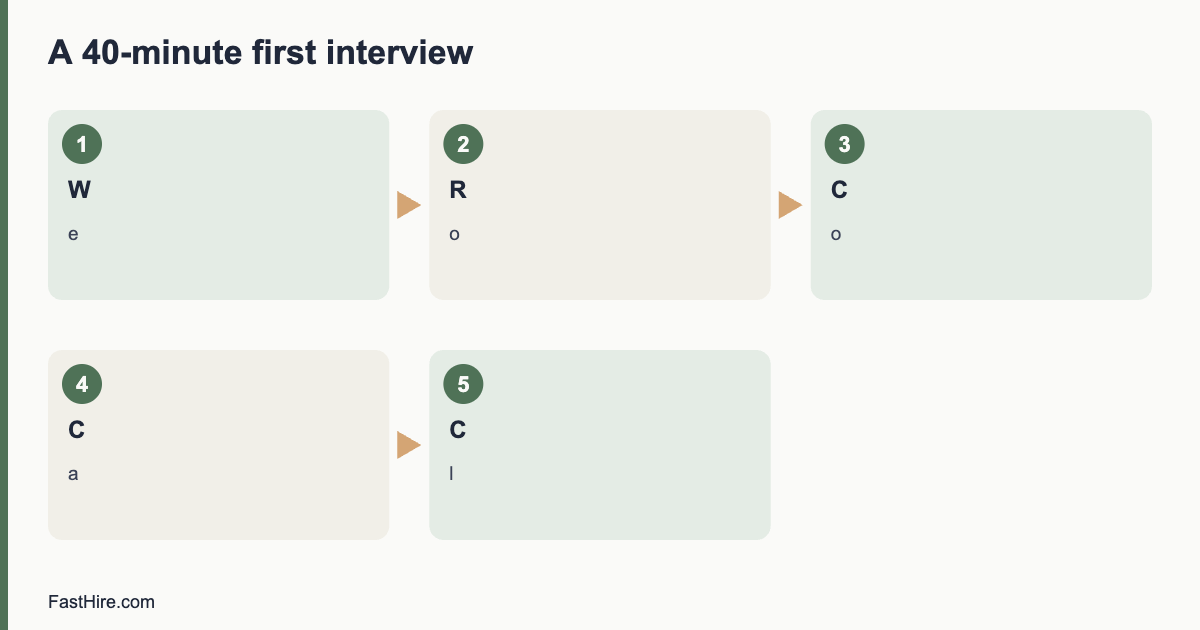
  • How to give fast interview feedback without cutting corners

    How to give fast interview feedback without cutting corners

    To give interview feedback fast without cutting corners, decide the standard before you interview, write short notes during the interview, score each candidate within hours, and send an outcome within two working days. Give every candidate a clear result. Offer two or three job-related reasons to candidates who reach the late stages. Never mention protected traits or compare people.

    Key takeaways

    • Set a response time for each stage and tell candidates what it is.
    • Take notes and score while the interview is fresh. Feedback follows from the scorecard.
    • Everyone gets an outcome. Later-stage candidates get short, specific, job-related reasons.
    • Keep the message kind, factual and short. Do not argue, compare or guess.
    • Avoid risky content: protected traits, hints about age or family, and promises you cannot keep.
    x

    Why speed matters

    For a candidate, an interview is a large effort. They prepare, take time off and share their experience. Silence after an interview feels like rejection, and it leaves a bad memory of your business. Slow feedback also costs you good candidates: people with several options accept the first clear offer. A clear, quick message protects your reputation and keeps strong candidates engaged. It also helps people who are not selected to move on.

    Speed does not mean carelessness. The risk of fast feedback is that you say something vague, personal or inaccurate. The answer is preparation: decide what you will say, based on the scorecard, before the interview ends.

    Set a service standard

    StageStandard (suggested)Message
    Application receivedAutomatic reply immediately, human reply within 2 working daysThanks; closing date; next step date
    After screeningWithin 2 working days after the screening dateInvite or decline with a brief reason
    After a phone screenWithin 2 working daysInvite or decline
    After an interviewWithin 2 working days, or by the date you gaveNext step or decline with job-related reasons
    After final interviewWithin 2 to 3 working daysOffer, or decline with specific, job-related feedback
    After an offer is acceptedSame dayTell other finalists

    These times are suggestions. Pick times you can keep, then put them in the job ad and the invitation. A promise you keep is better than a short promise you break. See the recruiter kickoff meeting for how to agree response times with your recruiter or HR partner.

    Fast feedback in four steps

    Step 1: Capture evidence during the interview

    Use a notes sheet with a box for each question. Write facts and short quotes. This is the raw material of the feedback. Without it you rely on memory. Learn the method in our guide to interview scorecards.

    Step 2: Score within two hours

    Score right after the interview, before the next one begins. Use your agreed scale. Write one line for each score. This also prepares the debrief meeting.

    Step 3: Choose the message type

    Decide the outcome and match it to a template: move forward, hold, or decline. For declines, choose between a short message and one with specific feedback. Use specific feedback for finalists.

    Step 4: Send, record and follow up

    Send the message by email, or phone for finalists. Record the date. If the candidate replies with questions, answer once, kindly, with the same facts. Do not enter a long debate.

    What to include in feedback

    IncludeExampleWhy
    A clear result“We will not move forward with your application.”No one should guess
    A thank you“Thank you for the time you gave to the interview.”Respect
    One to three job-related reasons (late stages)“For this role we needed more experience in X. Your examples were stronger in Y.”Helps the candidate learn
    A positive, true point“Your explanation of how you handled the delayed shipment was clear.”Balance and honesty
    What happens next“We will keep your details for 6 months if you agree.”Clarity; check the data rules
    Contact“If you have questions, reply to this email.”Open door

    Do not add pity, empty praise or false hope. Do not promise that “we will definitely call you for the next role” unless you will.

    What not to say

    Do not sayWhySay instead
    “You were too old / too young for the team.”Age discriminationKeep reasons to the job criteria
    “We found someone who is a better culture fit.”Vague; can hide bias“We selected a candidate whose experience in X matched the role most closely.”
    “The other candidate was stronger than you.”Comparison; may reveal personal data“We needed stronger evidence of X.”
    “You seemed nervous.”Subjective; may relate to disability or anxiety“We needed more detail in your examples.”
    “We are not sure why, the manager just did not like you.”Not a valid reasonReview your reasons before you send
    “You asked about leave / children.”Risk of discrimination claimsDo not refer to such questions in the decision

    If you are unsure about a statement, leave it out. A simple “we selected another candidate” is better than a risky reason. Remember that notes and messages may be requested by the candidate under data protection or legal processes. Write only what you can stand behind.

    Templates

    Decline after screening

    Hello [Name],

    Thank you for applying for the [job title] role. We reviewed your application against the requirements for this role. We will not move forward with it at this stage. We appreciate your interest and wish you well in your search.

    Best wishes,
    [Name]

    Decline after an interview, with feedback

    Hello [Name],

    Thank you for meeting us on [date]. We enjoyed hearing about [specific, true point]. After comparing all candidates against the same criteria, we have decided not to move forward. For this role, we needed more experience in [skill]. If you would like to ask a question, you can reply to this email. We wish you every success.

    Best wishes,
    [Name]

    Hold message

    Hello [Name],

    Thank you for your interview. We need until [date] to finish our interviews. We will contact you by [date] with a decision. Thank you for your patience.

    Best wishes,
    [Name]

    Move forward

    Hello [Name],

    Thank you for your interview. We would like to invite you to [next step] on [date options]. It will take about [time]. If you need any adjustment, please tell us.

    Best wishes,
    [Name]

    Handling pushback

    1. Thank the candidate for the reply and keep the tone calm.
    2. Repeat the job-related reason, in the same words.
    3. Do not reopen the decision unless you find a clear mistake.
    4. If the candidate raises a discrimination concern, do not argue. Record the message, thank them, and escalate to HR or a legal advisor.
    5. Close politely: “We appreciate your interest and wish you well.”

    Do not share notes about other candidates. Do not give details that would reveal who else applied. If a candidate formally asks to see the data you hold about them, follow the data protection rules. In the UK and EU, see the ICO employment pages and the GDPR.

    Internal feedback to interviewers

    Feedback is also useful inside the hiring team. After each process, hold a 15-minute review with the interviewers. Ask what made scoring easy or hard, and which question gave the best evidence. Update your question list. Over time the process speeds up, because the questions and scoring guides improve.

    Give each interviewer a short note about their notes: Were they specific? Did they stay on the criteria? Did they avoid unsuitable questions? Be kind and specific. See also structured interviews for a method that makes this easy.

    A worked example (fictional)

    A hiring manager interviews four finalists for a logistics planner. She writes notes on a sheet and scores each person within an hour. On Friday afternoon she sends a hold message to all four and tells them she will decide by Tuesday. On Monday she holds a 30-minute debrief with the recruiter and one colleague. On Tuesday morning she calls the chosen candidate, then sends three decline emails by noon. Two use the short template. One goes to the runner-up and says: “Your planning example from the warehouse project was strong. For this role we needed more experience with the specific scheduling system we use. We would like to keep your details for six months if you agree.” The runner-up replies with thanks, and agrees. Total time spent on feedback: 45 minutes.

    A feedback checklist

    • Response times set and shared with candidates
    • Notes taken during the interview
    • Scores written within two hours
    • Message type chosen
    • No protected traits or comparisons mentioned
    • One to three job-related reasons for late-stage candidates
    • Date recorded in the tracking sheet
    • Data kept and deleted on schedule

    Feedback for different outcomes

    OutcomeWho gets itLengthContact method
    Declined after applicationAll declined applicants2 to 4 sentencesEmail, template
    Declined after a phone screenAll screened candidates3 to 5 sentencesEmail, template
    Declined after first interviewAll interviewed candidates5 to 7 sentences with one or two reasonsEmail
    Declined after final interviewFinalistsA short call or a detailed email with two or three reasonsCall, then email
    Offer madeChosen candidateCall first, then letterCall and email

    A call is a kind gesture for finalists. It lets them ask a question and ends the process with respect. Keep it to five minutes. Tell them the outcome in the first sentence, then give the reasons.

    A script for a feedback call

    1. Say the outcome first. “Thank you for your time. I am calling to tell you that we have decided to offer the role to another candidate.”
    2. Thank the person. “We valued the effort you gave to the process.”
    3. Give two or three job-related reasons. “For this role we needed more depth in X. Your examples of Y were strong.”
    4. Invite one question. “Is there anything you would like to ask?”
    5. Close. “We would be glad to keep your details for future roles, if you agree. We wish you every success.”

    Do not read out comments from other interviewers. Do not make a promise about future roles unless you plan to keep it. Write a two-line note after the call about what you said.

    Make feedback part of your process, not extra work

    Feedback becomes slow when it is a separate task. Build it into the process. Put a “message sent” column in the tracking sheet. Block 30 minutes in your calendar on the day after each interview block. Save templates in your email so that you can send them in a click. Set a rule with your recruiter: for each rejected finalist, the recruiter sends the message, and the hiring manager supplies two bullet points of job-related reasons. This division of work cuts the time and keeps the tone consistent.

    If you use software to track applicants, check whether it can send templates and record dates. Whatever you use, people must decide and write the reasons. Tools can help send and track, but they cannot know the reasons for a decision.

    Frequently asked questions

    How fast should interview feedback be?

    Within two working days is a good standard. Tell candidates the date you will contact them and keep it.

    Do I have to give reasons to every candidate?

    Not always. Everyone should get an outcome. Give brief reasons to candidates who reached the later stages, if you can do it safely and fairly.

    Is it risky to give feedback?

    It can be if you include protected traits, comparisons or opinions. Keep to job-related reasons from your scorecard.

    What if I do not have time?

    Use templates. A short, polite decline takes less than five minutes and is far better than silence.

    Can candidates see my notes?

    In some places, yes, through data protection rights. Write notes that are factual and job-related.

    Related guides

    This is general information, not legal advice.
  • Recruitment metrics: eight numbers worth tracking

    Recruitment metrics: eight numbers worth tracking

    Eight numbers cover most of what a recruiting team needs to know: how many applicants come in, where they come from, how fast they move, where they leave, how many accept, how they rate the process, how long hiring managers take to respond, and whether results differ unfairly between groups. Track these from your own records, review them monthly, and ignore the rest until these are reliable.

    Key takeaways

    • Start with eight numbers, all counted from your own records.
    • Define each number in writing so that every recruiter counts the same way.
    • Always read a number together with its sample size. Five hires is not a trend.
    • Use numbers to find process problems, not to rank people.
    • Add fairness checks, but follow your country’s rules on collecting monitoring data.
    x

    Why fewer numbers work better

    Most applicant tracking systems can produce dozens of reports. A team that tries to read all of them usually reads none. Reports also fail when nobody agrees on what a word means. If one recruiter counts “time to hire” from the day the job was posted and another counts it from the day the candidate applied, the average is meaningless.

    So the first job is not building a dashboard. The first job is a one-page definitions sheet. Write each metric, the start event, the end event, who records it and where. Keep it next to the numbers. Our guide to time to hire and time to fill shows why those two terms must be kept apart.

    The eight numbers

    #MetricHow to calculate itWhat it tells you
    1Applicants per roleCount of applications received for one role, by weekWhether the advert reaches enough people, or too many
    2Source of applicants and hiresCount by source, for both applicants and hiresWhich channels bring people who are hired, not only people who apply
    3Time to hireDays from the date a candidate applied (or was first contacted) to the date they accepted an offerHow long a candidate waits for a decision
    4Time to fillDays from the date the role was approved to the date the offer was acceptedHow long the business waits for the seat to be filled
    5Stage conversionCandidates who moved to the next stage divided by candidates who entered the stageWhere people leave the process, and whether a stage is too strict or too loose
    6Offer acceptance rateOffers accepted divided by offers madeWhether the offer, the pay or the process is a problem late in the process
    7Hiring manager response timeDays between sending a shortlist or request and receiving feedbackWhether delays come from the recruiting team or from managers
    8Candidate experience ratingAverage answer to one question asked after the process, plus commentsWhether the process feels clear and respectful

    Fairness checks are a ninth item, but they are not a single number. See the section on fairness below.

    1. Applicants per role

    Count applications weekly, not only at the end. A role that gets four applicants in two weeks has an advert or channel problem. A role that gets 600 in two days has a screening-capacity problem. Both need different actions. For the second case, see our guide to screening at volume.

    Be careful with one trap: a large pile is not a sign of success. If most applicants do not meet the basic requirements, a clearer advert will help more than more promotion.

    2. Source of applicants and hires

    Record the source at the moment of application, using a required field. Free-text fields produce messy data such as “LinkedIn”, “linkedin” and “LI”. Use a fixed list: career page, job board, referral, agency, direct outreach, event, other.

    Then compare two columns for each source: the share of applicants and the share of hires. A channel that sends 50 percent of applicants and 5 percent of hires is costing review time. A channel that sends 5 percent of applicants and 30 percent of hires deserves more attention. With small numbers, treat these as clues, not proof.

    3 and 4. Time to hire and time to fill

    Time to hire measures the candidate’s experience. Time to fill measures the business’s experience. Report both, and add the median as well as the average. A single role that stayed open for 200 days can pull the average up, while the median shows the typical case.

    Split the time into stages so you can act: application to first contact, first contact to first interview, last interview to decision, decision to offer, offer to acceptance. Often most of the delay sits in one gap. In many teams that gap is the wait for hiring manager feedback, which is why metric 7 matters. For ways to shorten the process, read how to reduce time to hire.

    5. Stage conversion

    For each stage, divide the number who moved on by the number who entered. Look at the whole funnel for one role, then compare roles of the same type. Two questions help. Is a stage rejecting almost everyone? Then the requirement or the question may be too strict, or the advert may be attracting the wrong people. Is a stage passing almost everyone? Then it may not be doing any work, and you may be spending interview time on people you could have assessed earlier.

    A fictional example: a team screens 120 applicants for a customer support role. 40 pass the screening review, 20 take a call, 10 attend an interview, 3 receive an offer and 2 accept. The step from screening review to call is 50 percent, from call to interview 50 percent, from interview to offer 30 percent and from offer to acceptance 67 percent. These numbers are invented to show the arithmetic. They are not a benchmark.

    6. Offer acceptance rate

    Divide accepted offers by offers made. When the rate is low, ask the people who declined why. Use a short, neutral message: “Thank you for considering us. Would you tell us the main reason you chose not to join? Your answer will only be used to improve our process.” Common reasons are pay, a better offer, slow communication, unclear role content or a change in the candidate’s plans. Write the reasons down and count them. After 10 or 15 answers you will often see a pattern.

    7. Hiring manager response time

    This is the metric many teams avoid, and it is often the most useful. Record the date you send each request to a manager and the date they reply. Share the figures with managers in a neutral way, with the message that the aim is to help candidates, not to blame anyone. Pair this with a simple agreement, such as “feedback within two working days”, and use our guide to giving fast interview feedback.

    8. Candidate experience rating

    Ask one question and one open comment box after the process ends, to candidates who were hired and to those who were not. The question can be: “How clear was our communication, from 1 (not clear) to 5 (very clear)?” Do not ask candidates to rate their interviewer by name. Keep answers anonymous when you report them. A low score with comments such as “I never heard back” points directly to the standard in how to avoid ghosting candidates. The wider candidate experience checklist lists what to check.

    How to set the numbers up in a week

    1. Day 1: write definitions. One page, eight metrics, start and end events.
    2. Day 2: check the data fields. Make sure your system records application date, source, stage dates, offer date, acceptance date and decline reason. Make source a required fixed list.
    3. Day 3: export last year’s data for a few roles. Calculate the eight numbers by hand for three or four roles. This shows where the data is missing.
    4. Day 4: fix the gaps. Add missing fields, correct dates and agree who enters what.
    5. Day 5: build one view. A spreadsheet with one tab per month is enough to begin. A simple table with the eight numbers, the previous month and a short comment column works well.

    Fairness checks, with care

    Hiring numbers can also show whether a stage affects some groups differently from others. This is sensitive, so follow a few rules. Collect monitoring data only where the law and your policy allow it. Tell applicants why you ask, keep it optional and separate from decision records, and do not show it to people who screen applications.

    In the United States, the Equal Employment Opportunity Commission and the federal Uniform Guidelines describe a rule of thumb called the four-fifths rule. It compares selection rates between groups. The rule is a signal for further review, not a legal test on its own. See 29 CFR 1607.4 in the Code of Federal Regulations and read the explanation in our four-fifths rule guide. Current federal enforcement priorities have changed, so check the latest guidance and your state and local rules.

    In the UK and the EU, the data you collect about protected characteristics is special category data under data protection law. You need a lawful basis and an additional condition, and you should limit access. The UK Information Commissioner’s Office has guidance on recruitment and selection. Rules differ across EU member states, so ask your data protection officer or a local adviser.

    Whatever the country, group sizes matter. If a group has eight applicants, one decision changes the percentage by more than 12 points. Do not draw conclusions from very small groups. Use the check to ask questions about the process, such as “Is this requirement necessary?”, and not to blame individuals.

    A monthly review agenda

    TimeItemOutput
    5 minRead the eight numbers against last monthThree changes that stand out
    10 minOpen roles with the longest waitOne action per role, with an owner
    10 minStage conversion for the biggest roleDecision on any requirement or question to change
    5 minSource mixDecision to keep, cut or test a channel
    5 minCandidate commentsTwo comments to act on

    Keep the review to 35 minutes. Write the actions in the same document as the numbers, and start the next meeting by checking whether they were done.

    Mistakes to avoid

    • Changing definitions mid-year. If you must change one, mark the date on the chart and do not compare across the change.
    • Reading small samples as trends. With fewer than about ten hires in a period, describe the cases instead of calculating averages.
    • Using numbers to rank recruiters or candidates. Metrics should show process problems. A recruiter with a long time to hire may be working on the hardest roles.
    • Counting only fast hires as good hires. Speed matters, but so does fit. Follow up with the hiring manager at 90 days to check how the new hire is doing.
    • Ignoring data protection. Keep only the data you need, for only as long as you need it, and delete on schedule.

    FastHire is being built to help with the evidence part of the process. It shows each job requirement next to the exact CV passage that supports it, so reviewers spend less time searching and more time deciding. FastHire is coming soon. It does not rank, score or reject candidates. People make every decision.

    Frequently asked questions

    Which metric should I start with?

    Start with the stage dates. Once you record when each candidate enters and leaves each stage, you can calculate time to hire, stage conversion and manager response time from the same data.

    What is a good time to hire?

    There is no single good number. It depends on the role, the country and the labour market. Compare your own roles with each other and with your own past results, and ask candidates how the wait felt.

    Can a spreadsheet replace an applicant tracking system for reporting?

    For a small team, yes. A shared spreadsheet with one row per candidate and a column for each stage date is enough to calculate all eight numbers. Move to a system when volume makes manual entry slow.

    Is it legal to collect gender or ethnicity data on applicants?

    It depends on the country and the purpose. Rules differ in the US, the UK and each EU member state. Check the official guidance linked above and ask a specialist before you start.

    How often should I review the numbers?

    Monthly for the full review, and weekly for open roles that are late.

    Related guides

    This is general information, not legal advice.
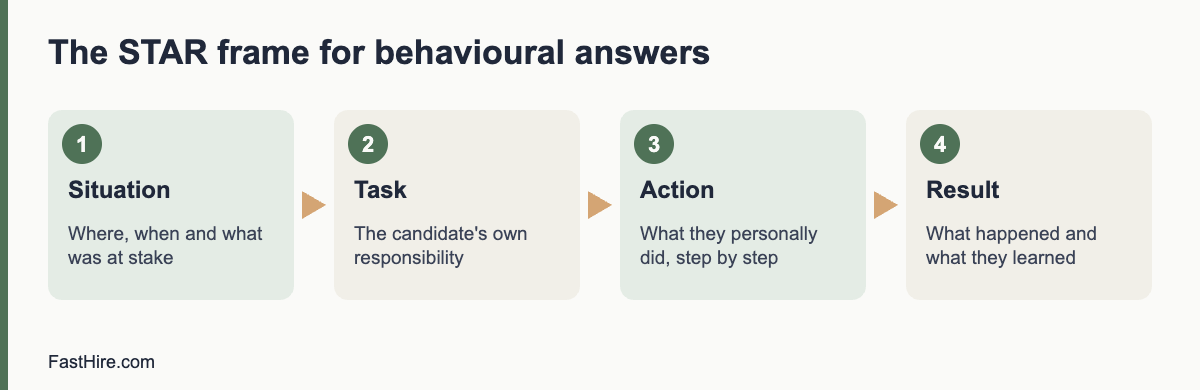
  • Applicant privacy notice: what to include, with a template

    Applicant privacy notice: what to include, with a template

    An applicant privacy notice is a short page that tells candidates who you are, what data you collect, why, who sees it, how long you keep it and what rights they have. This guide lists every item to include and gives a template you can adapt, with notes for the UK, the EU and the United States.

    Key takeaways

    • Show the notice on the application page, before the candidate submits anything.
    • Use plain language and short sentences. Candidates are not lawyers.
    • Cover: who you are, what data, why, lawful basis, who receives it, transfers, retention, rights, complaints and automated tools.
    • Match the notice to what you really do. If your process changes, change the notice.
    • Have a specialist read your final version. This guide is a starting point.
    x

    Who needs a notice

    In the UK and EU, GDPR requires you to give people information about how you use their personal data. This is often called a privacy notice or fair processing notice. If you collect data directly from the applicant, you give the information when you collect it. If you get data from another source, such as a recruiter database or a public profile, you generally give the information within a reasonable time and at the latest within one month. See Articles 13 and 14 of the GDPR, and the Information Commissioner’s Office guidance on recruitment and selection.

    In the United States there is no single federal privacy notice rule for applicants. Some states do have rules. For example, California privacy law gives job applicants certain rights and notice requirements. Rules change, so check the official sources for each state where you hire. Many US employers publish a notice anyway, because it builds trust and prepares them for new rules.

    What to include

    ItemWhat to writeNotes
    1. Who we areCompany name, address and contact for privacy questionsAdd the data protection officer if you have one
    2. What data we collectCV, contact details, work history, education, answers to questions, interview notes, test resultsSay where it comes from: the candidate, referees, recruiters or public sources
    3. Why we use itTo assess applications, run interviews, decide, make offers and meet legal dutiesSeparate the purposes. Mention monitoring and talent pools if used
    4. Lawful basis (UK and EU)Steps before a contract, legitimate interests, legal obligation, consent for talent poolsMatch the basis to each purpose
    5. Who sees itHiring team, HR, software providers, referees, background check providers with consent or legal basisName categories of recipients
    6. Transfers abroadSay if data goes outside the UK or EU and what protection appliesAsk your software providers where data is stored
    7. How long we keep itA specific period for each group of recordsDo not write “as long as necessary” alone
    8. RightsAccess, correction, deletion, restriction, objection and, where relevant, data portabilitySay how to make a request and how fast you reply
    9. ComplaintsThe right to complain to the data protection regulatorName the regulator for your country
    10. Automated toolsSay if software supports screening or decisions and how a person reviews the outcomeBe specific and honest
    11. Is the data required?Say what happens if the candidate does not give informationExample: without a CV we cannot assess the application

    A template you can adapt

    Copy the text below into your application page and replace the words in square brackets. This is a template. It is not legal advice, and your facts may differ.

    How we use your information when you apply
    [Company name] (“we”) is responsible for your information. You can contact us at [email] with any question about this notice.
    What we collect: your name and contact details; your CV or resume; your work history, education and skills; your answers to our questions; notes and scores from interviews and tests; and information from referees, if you give us their details and we have told you before we contact them.
    Why we use it: to read and assess your application for [role], to invite you to interviews, to decide who to offer the job to, to make an offer, and to meet legal duties. We rely on [steps before entering a contract and our legitimate interest in running a fair recruitment process].
    Who sees it: the people involved in hiring for this role, our HR team, and the providers that supply our recruitment software. They may only use your information for our purposes. [We store data in the country or region of storage.]
    How people make decisions: [People make all decisions about who to interview and hire. Our software may highlight text in your CV that matches the job requirements, but it does not reject or rank you. / Describe any other tools and how a person checks the result.]
    How long we keep it: if we do not hire you, we delete your application [number] [months] after the process ends, unless you agree that we may keep it for future roles. If you agree, we keep it for [number] [months] and ask again before then.
    Your rights: you can ask us for a copy of your information, ask us to correct it, ask us to delete it in some cases, and object to some uses. Write to [email]. We reply within [one month] [or the period required by law]. You can also complain to [name of regulator and website].
    If you do not give us the information we ask for, we may be unable to consider your application.

    Notes for each region

    United Kingdom

    Name the Information Commissioner’s Office as the regulator. UK law uses “UK GDPR”. The Data Protection Act 2018 adds rules, for example on criminal offence data and special category data. If you ask for criminal record checks, they are limited by law and by the role.

    European Union

    Name the national authority for the country of your main establishment, and mention that candidates can complain in their own member state. Local labour law may add rules on retention and on what you may ask in interviews. The European Data Protection Board publishes guidance.

    United States

    Include a short statement of what you collect and why, and whether you sell or share data. Check state laws if you hire in places with comprehensive privacy rules. Employers that use automated employment decision tools in some cities may also need to give notice, for example in New York City. See the city guidance on automated employment decision tools, and our guide to Local Law 144 when it is available.

    Where and how to show it

    • On the application page, with a clear link above the submit button. A link in a footer is not enough.
    • In the confirmation email, with a link to the full notice.
    • In job adverts on third-party boards, with a link to your notice where you can.
    • In plain text, not only in a PDF. Many candidates apply from a phone.
    • In the local language of the candidate where you hire in that country.

    Writing tips

    1. Use “we” and “you”. It is clearer than “the data controller” and “the data subject”.
    2. Write short sentences. Aim for fewer than 20 words.
    3. Use a table or short sections. People scan.
    4. Avoid vague words. Replace “may” and “from time to time” with real examples.
    5. Test with a colleague outside HR. Ask them what you do with their CV. If they cannot say, rewrite.
    6. Keep a version history. Note the date and what changed, so you can show which notice a candidate saw.

    Mistakes to avoid

    MistakeWhy it is a problemFix
    Copying a notice from another companyIt describes their processes, not yoursWrite from your own data map
    Saying “we keep data as long as necessary”Candidates and regulators expect a clear periodGive a specific time for each record type
    Hiding the notice in the footerApplicants cannot see it before they submitPlace it next to the form
    Describing a feature that you do not useThe notice becomes untrueReview with the recruiters who use the system
    Promising never to share data, while using many providersThis is untrue and riskyName categories of recipients

    FastHire is being built to support a clear and open process. It shows each job requirement next to the exact CV passage that supports it. People make every decision. FastHire does not rank, score or reject candidates, and it is coming soon.

    Layered notices: a short summary and a full text

    Long notices go unread. A layered format helps. The first layer is a box of five or six lines next to the form. The second layer is the full notice, one click away. Both layers must agree with each other and with what you do.

    LayerContentLength
    Layer 1: summary boxWho we are, why we use your data, who sees it, how long we keep it, how to see or delete it, link to full noticeAbout 60 to 100 words
    Layer 2: full noticeAll items in the table above, with headingsOne to two pages
    Layer 3: just-in-time messagesA short line next to sensitive questions, such as “This question is optional and is used only for monitoring”One sentence

    Here is a fictional example of a layer 1 box: “We use your CV and answers to assess your application for this role. Our recruiting team and our software provider can see them. If we do not hire you, we delete your data after six months unless you ask us to keep it. You can ask to see, correct or delete your data at any time. Read the full notice.” The six months in this example is invented. Choose your own period on advice for your country.

    Review checklist before you publish

    1. Does every data type in the notice match a field in the form and a field in the system?
    2. Does every tool that touches applicant data appear in the list of recipients?
    3. Is each retention period real, and does the system enforce it?
    4. Does the notice say what happens if a candidate refuses to give an optional item?
    5. Has someone who does not work in HR read it, and could they explain it back?
    6. Is there a named person who updates it when the process changes?

    Put a calendar reminder to review the notice every six months. Also review it when you add a country, change a vendor or turn on a new automated feature. Keep the older versions with dates.

    One last point on tone. A privacy notice is also a message to candidates about how you treat people. Plain, honest wording shows respect, and it is easier to defend than clever wording. If a sentence could be read two ways, choose the plainer way and cut the rest.

    Frequently asked questions

    Is a privacy notice the same as a cookie banner?

    No. A cookie banner is about cookies on your website. An applicant privacy notice is about how you use the data of people who apply for jobs. You may need both.

    Do I need candidate consent to process their application?

    Often no. In the UK and EU, other lawful bases can apply. Consent is common for talent pools and for optional questions. See our guide to GDPR for job applicants.

    How long should a notice be?

    As short as possible while covering the required items. A layered format works well: a short summary with a link to the full text.

    Do I need to update the notice when I change software?

    Yes, if the change affects what data you collect, who receives it, where it is stored or how decisions are supported.

    Does a US employer need this notice?

    There is no single federal rule, but state laws may require a notice. Check the states where you hire, and consider a notice as good practice.

    Related guides

    This is general information, not legal advice.